From solving climate challenges through research to preparing the next climate leaders, George Mason University is applying science, policy, and innovation to safeguard communities and ecosystems. And that commitment includes developing leadership and talent to produce solutions for our global community.
These interdisciplinary summer programs are helping the next generation of conservationists, environmentalists, and sustainability experts develop the critical skills needed to help build a climate-resilient society and a more resilient future.
Smithsonian-Mason School of Conservation
In Front Royal, Virginia, the Smithsonian-Mason School of Conservation (SMSC) opened its doors over the summer for high school students to gain college credit while exploring conservation through different but complementary perspectives: CONS 100 Introduction to Field Conservation Ecology and CONS 110 Natural History Illustration.
Students in CONS 100 participated in field investigations, testing research questions in a guided pilot study. In CONS 110, an online course, students learned to accurately observe and document the natural world through scientific illustration, with sketching practice, anatomical study, and lessons in different artistic mediums. Through both courses, students engaged in immersive, hands-on learning experiences that emphasize scientific inquiry, conservation, and observation.
“Whether they’re collecting field data or illustrating flora and fauna, we want the students to realize that observation is a powerful scientific skill,” said Robert Barrett, assistant director of recruitment and outreach for SMSC. “If they remember that conservation begins with paying close attention and that they have the ability to contribute through critical thinking and creativity, then they’ll carry something valuable with them long after the course ends.”
Together, these programs prepare the next generation of conservation leaders by teaching them the power of combining arts and sciences in observation, documentation, communication, and research to help communities adapt to environmental change and protect biodiversity. “By empowering students to translate observation into action, these courses contribute to the university's goal of building a more sustainable and climate-resilient society,” said Barrett.
Constellation Small Modular Reactor Summer Academy
Moving east from the mountains to Arlington, the inaugural Constellation Small Modular Reactor (SMR) Summer Academy at Fuse at Mason Square tackled questions of climate resilience through sustainable energy.
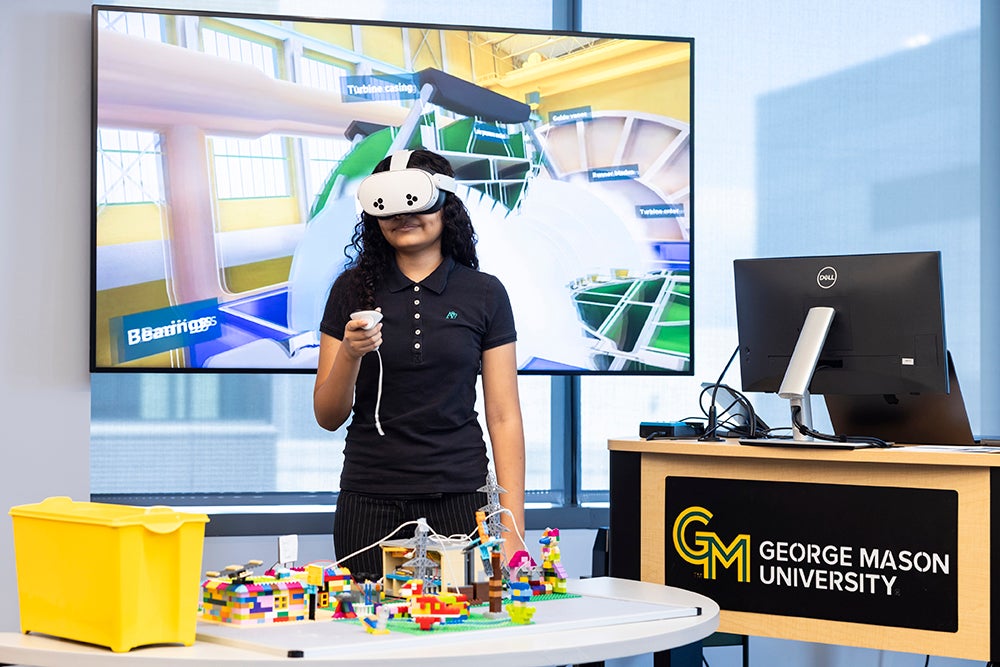
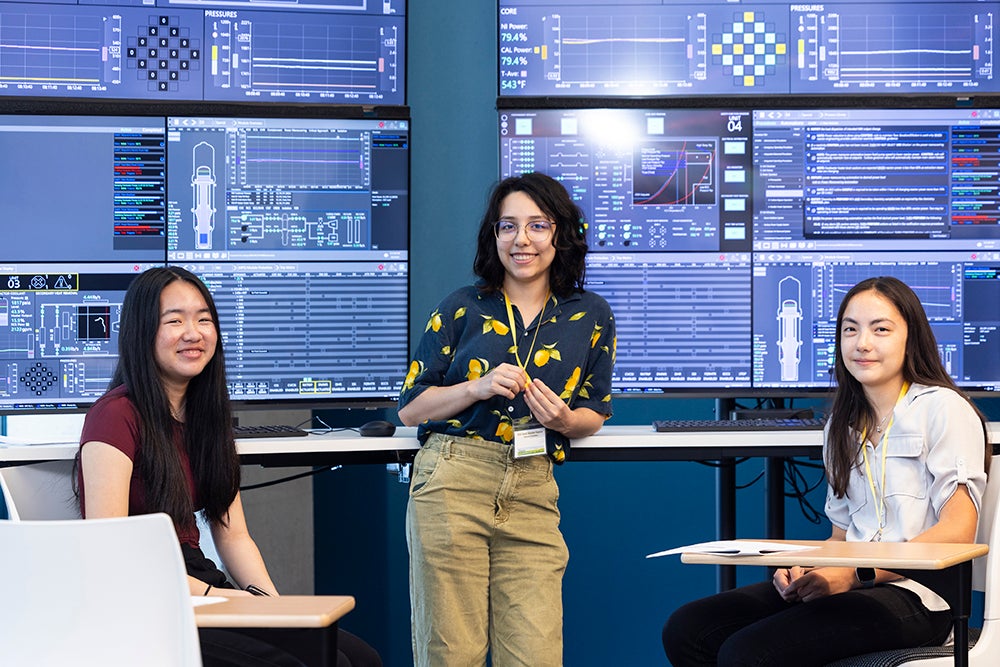
“The academy directly explores the challenge of providing reliable, resilient, and low-carbon electricity as demand continues to grow,” explained Liling Huang. During the week-long program, students participated in hands-on activities involving the NuScale SMR simulator at George Mason’s E2 Center, built Lego-based SMR applications, and took virtual reality tours of a nuclear power plant and renewable energy facilities. The camp concluded with a poster presentation competition attended by industry professionals.
“We want students to see the breadth of educational and career opportunities available in the energy industry,” said Huang.
By exploring potential solutions to the challenges of providing reliable, resilient, and low-carbon electricity, students began to develop the necessary skills to create a more resilient energy future.
“They can be a part of solving some of the most important energy challenges facing society,” said Huang. “They do not have to wait until they graduate from college to start thinking creatively, conducting research, and contributing ideas.”
Washington Youth Summit on the Environment
Across the Potomac River, the Washington Youth Summit on the Environment (WYSE) immersed students in the world of environmental conservation and sustainability. Over the course of one week, rising juniors and seniors in high school explored careers and developed the skillsets required to create actionable solutions, foster resilient communities, and ensure a sustainable future.
Led by faculty with expertise in environmental science, conservation, policy, law, and engineering, the youth delegates met with states’ U.S. Congressional Representatives and Senators; explored national and state parks, caverns, and waterways; toured the Smithsonian National Zoo and Conservation Biology Institute; and heard from industry professionals such as conservation photographers, environmental project managers, animal keepers, marine biologists, and many more.
A tentpole of the youth delegate experience was roleplaying exercises, such as an intensive problem-solving water quality simulation. These sessions allow students to apply what they’ve learned to real-world problems and develop solutions.
“These high school students learn tangible skills and connect on a human level, with a goal of being impactful, empowered, and trustworthy citizens at home and abroad,” said Dawn Aponte.
In This Story
Related news
- September 24, 2026
- September 24, 2026
- September 16, 2026
- September 2, 2026
- August 21, 2026