
"We make a living by what we get, but we make a life by what we give."
-Winston Churchill
This month, Avery Shippen graduated from George Mason University with a dual degree: A BS in Conflict Analysis and Resolution from the Jimmy and Rosalynn Carter School for Peace and Conflict Resolution, and a BA in Art and Visual Technology from the College of Visual and Performing Arts.
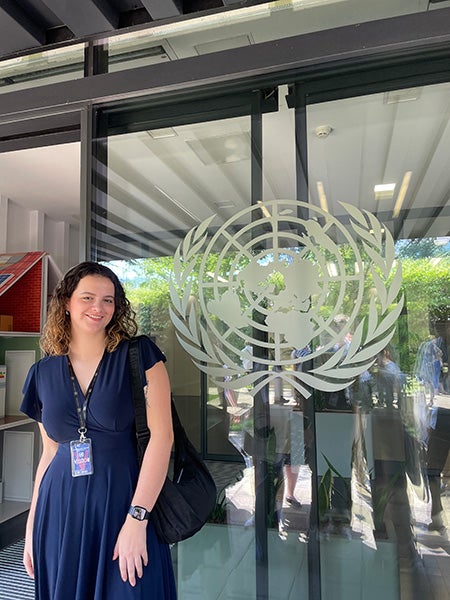
While managing the workload of a dual degree is impressive, even more impressive is the number of awards and fellowships she received during her time at Mason. A member of the Honors College, she was one of the very few University Scholars. She also earned the Peraton Scholarship in National Security, the Carter School’s Oxford Scholarship, the Noah J. Seidenberg Award, the Peacebuilding Fellowship, and others.
When asked about the opportunities these awards had opened for her, Shippen explained that the scholarships and fellowships provided a financial “safety net,” giving her the ability to gain valuable life experience, such as being the first Carter School student to attend the Oxford Consortium for Human Rights in War and Climate Emergency Conference or to study-abroad in Bosnia and Croatia. The awards also provided Shippen the financial freedom to undertake several internships which allowed her to explore the real-world applications of the skills she learned in both academic programs.
To Shippen, the fusion of the two majors, graphic design and conflict resolution, was a natural pairing. “I think both fields work to connect communities. People see conflict resolution as a scientific process, but it’s deeply rooted in people,” she explained. “Graphic design creates a ‘language’ which anyone can understand, which can be effective in building the peacebuilding process.”
Shippen held three internships before graduating. One of her internships was with the World Affairs Councils of America, where she was employed at a Global Education Intern. She proudly described how she coordinated the logistics of the annual event, which brings high school students from across the country to D.C. to learn about global engagement and public diplomacy. Shippen also interned with The Defense Counterintelligence and Security Agency under the Department of War. “I saw each side of government and federal contracting,” she said. “Each had a very different approach to resolving conflict.”
When asked how her academic life might have been different without the support of numerous awards, she paused for a moment. “I didn’t seek recognition. Instead, I sought opportunities that aligned with my personal values.” She added that “the awards put me in a position to give back and inform other students about the opportunities that exist at Mason.”
Shippen applied to several graduate programs, including the Carter School’s Dual Master's Degrees in Conflict Resolution and Mediterranean Security with the University of Malta, and was accepted to all of them. However, Shippen decided to enroll in the Master’s program in Global and Comparative Education/International Education Policy Analysis at Stanford University. She explained that her interest in curriculum development stemmed, in part, from the work she performed as part of the Peacebuilding Fellowship. After researching the Appalachian educational curriculum, Shippen wrote a proposal to the school district that recommended a systemic curriculum change that placed greater emphasis on practical and sustainable life skills and de-emphasized rote memorization.
Shippen’s experience in Bosnia and Croatia also contributed to her interest in educational systems development. While studying ethnic narratives in conflict, Shippen found that each of the three major ethnic groups had their own, independent school system and curriculum. Essentially, how and what students learned in any given subject, depended on the ethnic group to which they belonged. “After speaking with students there, I realized that the conflict analysis skills I learned can be a valuable tool in engaging youth and educational systems,” she explained.
When asked what the future holds for her, Shippen responded that she’d like to be a Curriculum Development Specialist, “so she can have an impact on the type of education youth receive.”
Carter School News
- June 1, 2026
- May 29, 2026
- May 27, 2026
- April 30, 2026
- April 27, 2026