
The Center for Peacemaking Practice (CPP) at George Mason University Jimmy and Rosalynn Carter School for Peace and Conflict Resolution brings together students, faculty, staff, affiliates, and visiting fellows to study conflict resolution practice, integrate practitioner knowledge into theory-building, and develop and share research insights relevant to practice. The center works directly with those engaged in conflict-affected contexts—locally, nationally, and internationally, emphasizing lived experience, field-based knowledge, and practitioner reflection to advance the field and strengthen theory.
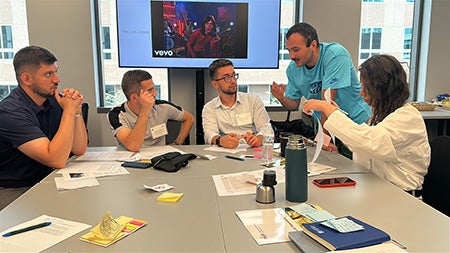
The center has engaged partners across multiple regions, including Latin America, East Asia, Southeast Asia, and the former Soviet space, with a sustained focus on the South Caucasus. This engagement has taken different forms: facilitating practitioner workshops in the field, hosting reflection spaces at the Carter School, building communities of dialogue conveners, and supporting longer-term learning processes that connect experience to analytical and practical tools.
Over the years, the CPP has hosted both individual fellows and group-based programs. These included practitioners such as Alicia Pfund (Latin America), Matthew Graville (USA), and Dina Alborova (South Caucasus) and many others.
Occasional study visit programs for emerging and established peacebuilders allow the center to host visitors for short, one- to two-week periods. Some programs have hosted visitors from a wide range of regions, while others engaged participants from selected geographic areas.
In the past, the center has hosted Ukrainian and South Caucasus participants for intensive, learning and practice-oriented engagement, either as individuals or in small groups. For example, the center has hosted very promising young and mid-career peacebuilders such as Leila Sabina and Anna Chernova (Ukraine), Argam Movsisyan, Mher Taroyan and Hasmik Harutyunyan (Armenia), Nino Khalvashi, Dato Dolaberidza, Elene Tuzbaia (Georgia), Jalala Hajieva and Rahman Huseynzade (Azerbaijan).
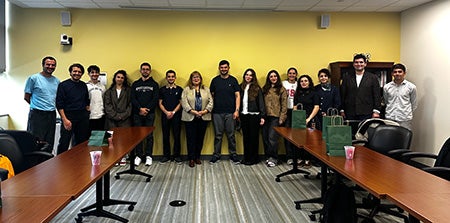
The CPP approaches new study visit opportunities with careful consideration. For example, the center’s leadership, including Carter School faculty members Susan Allen and Margarita Tadevosyan, is currently in exploratory conversations with young peace practitioners from Tbilisi, Sukhum/i and Tskhinval/i, identifying their interest, availability and capacity to participate in a specially curated digital media creators’ community of practice study visit to Mason in Fall 2026.
The CPP team has been in conversation with Mariami Shonia, Arnold Dzari-ipa, Giorgi Rivzhadze, Maria Khachirova, Eleonora Tchania, Adelina Umurzakova, Vitallii Kokoskeriia and Revaz Koiava—highly motivated, young peace actors whose perspectives reflect evolving approaches to peace in their home communities. One of the center’s goals is to work with digital media creators to address the growing role of digital spaces in shaping conflict narratives and public engagement.
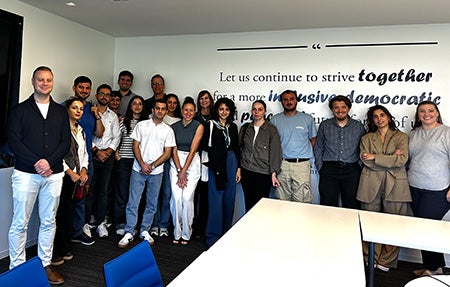
As the center explores program funding opportunities, the team is working to plan and implement an in-person program that will convene practitioners and media actors to deepen their skills, exchange perspectives, and develop more conflict-sensitive approaches to communication in and between their home communities.
Interested in gaining this kind of hands-on experience? Learn more about our admissions process or apply to the Carter School today.
Carter School News
- September 23, 2026
- September 23, 2026
- September 10, 2026
- September 2, 2026
- August 11, 2026