From its Fairfax Campus in Virginia, to Washington, D.C., to the 2026 Quantum World Congress in College Park, Maryland, George Mason University spent the week demonstrating how universities can help turn the promise of quantum technology into research, workforce opportunities, infrastructure, partnerships, and economic impact.
The university’s engagement came at a pivotal moment. Quantum World Congress (QWC26), held September 23-25, brought together leaders from science, industry, government, finance, and education to advance quantum technologies from research toward commercialization and real-world application. Cody W. Edwards, dean of George Mason’s College of Science, delivered a QWC26 keynote focused on an important question for institutions and regions: Do we wait for quantum’s transformational technology to take shape or do we build the capacity to help shape the ecosystem now for the future.
The answer was clear: George Mason University is relying on its strengths to build.

“Quantum is now,” Edwards told the audience. Rather than trying to predict which quantum technology will ultimately prevail, he stressed that leaders should invest in the people, partnerships, infrastructure, and institutional flexibility needed to respond as the field evolves. He outlined three imperatives: build capacity ahead of the curve; build ecosystems rather than isolated assets; and begin with consequential problems while building solutions with partners.
That ecosystem-building approach was visible throughout the week.
Just ahead of QWC26, George Mason announced plans to establish the Virginia Quantum Hub, (VQH) supported by a $3.7 million GO Virginia grant, pending final award. Designed as an inclusive public-private quantum ecosystem, the VQH combines shared infrastructure, workforce development, and collaborative technology innovation. Its partners span industry, government, regional economic development groups, and education-focused collaborators including Northern Virginia Community College, Marymount University, Virginia Tech, and public schools in Fairfax, Arlington, and Loudoun County. Check go.gmu.edu/quantum for a current and growing valued partner network listing.
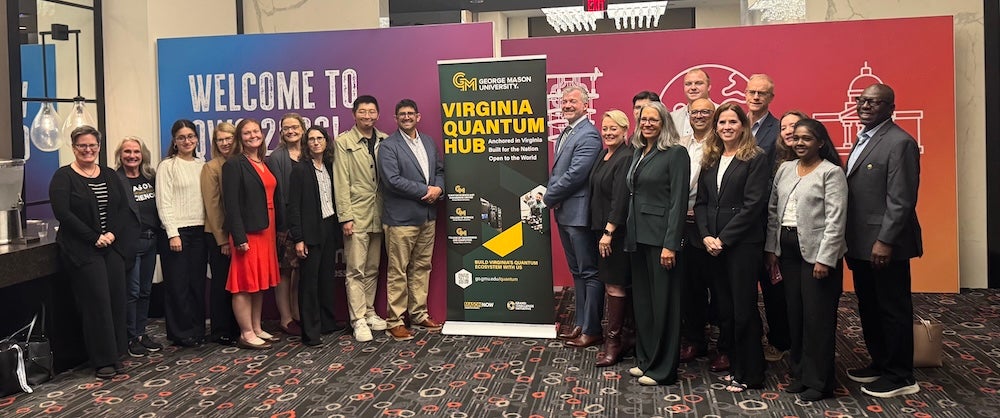
The Virginia Quantum Hub unveiling builds on another major milestone announced earlier in September: George Mason’s partnership with Oxford-based TreQ and Virginia Innovation Partnership Corporation (VIPC) to bring a $7.7 million open-architecture quantum computing system to Virginia. Planned for installation in early 2027 and commissioning by late summer, it will be the first open-architecture quantum computing system in Virginia and the National Capital Region and the first U.S. deployment based on TreQ’s Open Architecture Quantum framework.
As Edwards emphasized in his keynote, the significance goes beyond acquiring a computer. “We are not investing in a machine as an endpoint—we are investing in infrastructure as a platform.”
Open architecture gives researchers, students, startups, and established companies opportunities to build, test and integrate technologies while allowing the platform to evolve with processors, software, networking, and other parts of the quantum stack.
Importantly, the strategy puts people alongside technology. George Mason’s Quantum Science and Engineering Center (QSEC) connects 24 faculty across seven departments and several colleges, and the university has launched Virginia’s first interdisciplinary master’s degree in quantum science and engineering to scale up and reskill the necessary quantum workforce.
George Mason’s quantum education opportunities were shared earlier in the week, when President Gregory Washington, QSEC Executive Director Patrick Vora and university representatives participated in the Washington Post’s “Building America: Quantum Innovation” program in Washington, D.C., which extended conversations about quantum innovation into the broader national dialogue.
Vora detailed QSEC’s four-tiered educational development focus building on almost a decade of collaboration with local, regional, and nationally renowned educators, academic partners, and industry leaders, “The Virginia Quantum Hub plans to extend the talent pipeline through K-12 programs, community-college partnerships, professional education, internships and hands-on access to quantum infrastructure, all informed by industry’s quantum workforce needs now and in the future.”
Taken together, the week highlighted a consistent message: Quantum leadership will not come from one university, company, government agency or piece of technology. It will come from connecting talent, infrastructure, research, industry, capital, and mission.
As Edwards said: “George Mason convenes. Virginia benefits.” And the ambition extends well beyond the commonwealth: “Anchored in Virginia. Built for the nation. Open to the world.”
Topics

Read more about our work in quantum
- September 28, 2026
- September 22, 2026
- September 2, 2026
- August 18, 2026
- July 10, 2026