
One year ago, the Jimmy and Rosalynn Carter School for Peace and Conflict Resolution at George Mason University assumed one of the most significant international leadership roles in its history: serving as the United Nations Academic Impact (UNAI) Hub Chair for Sustainable Development Goal 16, Peace, Justice and Strong Institutions. This appointment placed the Carter School at the center of a global academic network dedicated to advancing one of the most challenging and consequential goals of the 2030 Agenda.
It was, of course, an honor.
But more importantly, it was a responsibility.
Twelve months later, this anniversary provides an opportunity not merely to celebrate an institutional achievement, but to ask a more important question: What should an academic institution actually do when entrusted with global leadership on peace, justice, and strong institutions?
The answer, I believe, lies in rethinking the relationship between universities and the United Nations.
Universities as Global Problem-Solvers
The world of 2026 is dramatically different from the one that gave birth to the Sustainable Development Goals in 2015.
Armed conflicts have multiplied. Democratic backsliding continues across many regions. Political polarization has deepened. Climate change increasingly intersects with insecurity and forced displacement. At the same time, trust in institutions, both national and international, has steadily eroded.
These interconnected crises cannot be solved by governments alone.
Nor can they be addressed solely through the work of the United Nations.
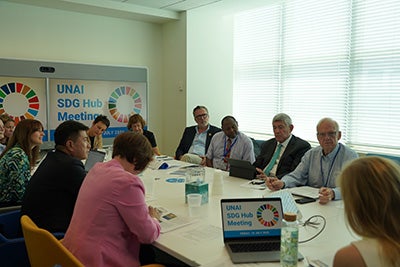
Universities possess a unique comparative advantage. They generate knowledge, educate future leaders, convene diverse perspectives, and, perhaps most importantly, provide spaces where difficult conversations can occur across political, cultural, and ideological divides.
Yet for too long, academia has remained at the margins of global policymaking.
The UNAI Hub initiative seeks to change that by positioning universities not simply as observers of global challenges, but as active contributors to solving them. Through a worldwide network of SDG Hubs, higher education institutions are expected to bridge research, education, policy, and partnerships in support of the 2030 Agenda.
Why SDG 16 Matters
Among the 17 Sustainable Development Goals, SDG 16 occupies a unique position.
Peace, justice, and strong institutions are not merely one goal among many. They are the enabling conditions upon which nearly every other SDG depends.
It is difficult to reduce poverty without functioning institutions.
It is difficult to improve education amid armed conflict.
It is difficult to promote economic development where corruption undermines public trust.
It is difficult to address climate change when governance systems are weak.
In other words, SDG 16 serves as one of the foundations upon which sustainable development itself rests.
This reality has become even clearer over the past decade. Development and peace can no longer be treated as separate policy communities. Increasingly, they represent two sides of the same challenge.
A Different Vision for the Hub
When the Carter School became the UNAI SDG 16 Hub Chair, we deliberately chose not to build another conventional academic network.
Instead, we asked a simple question:
How can the Hub become a platform rather than merely a program?
Our answer has been built around three guiding principles.
First, we have sought to strengthen collaboration across regions by working alongside our distinguished Vice Chairs: the University of Oxford for research, Narxoz University for teaching, and the University for Peace for outreach and partnerships. This distributed leadership model reflects the very values that SDG 16 promotes: collaboration, inclusivity, and shared ownership.
Second, we have placed young scholars and students at the center of our vision. Too often, discussions about peace and global governance occur without those who will inherit the consequences of today's decisions. The Hub therefore aims to amplify early-career voices by connecting them directly with United Nations practitioners and international experts.
Third, we have sought to narrow one of academia's oldest divides: the gap between knowledge and action.
Research should not end with publication.
Ideas should influence policy.
Innovation should reach practice.
Universities should become active partners in solving global problems rather than merely analyzing them.
The Next Frontier
Our first year has reinforced another important lesson.
The future of SDG 16 will increasingly depend upon interdisciplinary thinking.
Peacebuilding today cannot be separated from artificial intelligence, environmental change, public health, digital governance, migration, or technological innovation.
Strong institutions must also become adaptive institutions.
Justice must increasingly address digital spaces alongside physical ones.
Peacebuilding must engage not only diplomats, but also engineers, data scientists, urban planners, psychologists, and entrepreneurs.
This is why the Hub's work has increasingly focused on creating connections across disciplines rather than reinforcing traditional academic silos.
The complexity of today's global challenges demands nothing less.
Looking Toward 2030
The international community now has less than five years remaining to achieve the Sustainable Development Goals.
Most assessments suggest that progress remains far behind where it needs to be.
That reality should not lead to pessimism.
Rather, it should encourage innovation.
The remaining years before 2030 require new partnerships, new forms of leadership, and new ways of mobilizing knowledge.
Universities have an essential role to play.
Not because they possess all the answers.
But because they bring together perhaps the world's greatest concentration of curiosity, creativity, and critical thinking.
If properly connected to policymakers, civil society, communities, and international organizations, higher education can become one of the most powerful accelerators of sustainable development.
Beyond the Title
Serving as the UNAI SDG 16 Hub Chair has never been about institutional prestige.
Titles matter far less than impact.
Our ambition has always been to demonstrate that universities can become trusted global conveners, bringing together scholars, practitioners, students, and policymakers in pursuit of a common purpose.
One year on, I remain convinced that this is precisely where higher education can make its greatest contribution.
The challenges facing humanity are becoming increasingly interconnected.
Our responses must become equally interconnected.
Peace, justice, and strong institutions cannot be built by governments alone. Nor can they be built by universities alone.
But together, with genuine partnership, shared learning, and collective leadership, we can move closer to the vision that inspired the Sustainable Development Goals in the first place: a world where sustainable development rests upon peaceful, just, and inclusive societies.
One year has passed since the Carter School accepted this responsibility.
The real work, however, is only just beginning.
Carter School News
- August 6, 2026
- August 4, 2026
- July 23, 2026
- July 17, 2026
- June 11, 2026
More about SDG16
- July 23, 2026
- July 25, 2025
- January 23, 2025