
What if a robot could learn from another robot's experience instead of starting from scratch every time it encountered a new task? That question is at the center of new research by George Mason University assistant professor Xuan Wang, who received a five-year, $640,000 Faculty Early Career Development (CAREER) award from the National Science Foundation (NSF).
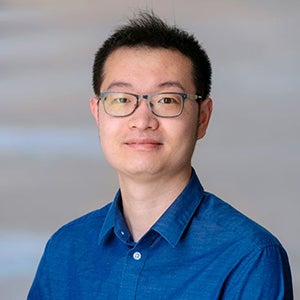
The CAREER award, NSF's most prestigious honor for early-career faculty, will support Wang's efforts to develop new methods that allow robots to transfer knowledge more efficiently, reliably, and safely across different tasks, environments, and even different types of robots.
Today's learning-based robots often require enormous amounts of data and repeated trial-and-error to master new tasks. Wang's research aims to dramatically reduce that burden by helping robots determine what information from previous experiences is actually useful and how to apply it effectively.
"Robot learning is very time-consuming and computationally expensive," said Wang. "The idea is to leverage knowledge that another robot has already gained instead of learning everything from the beginning."
The project combines Wang's background in control theory, optimization, and multi-agent systems with modern machine learning techniques. Rather than treating knowledge transfer as a collection of trial-and-error, Wang will develop a mathematical framework allowing robots to determine when transferred knowledge will improve performance and when it should be ignored.
"We want robots to reason about when transfer learning is beneficial and when it is not," he said. "If there are many other robots to learn from, how can a robot quickly identify which one will provide the most useful knowledge?"
Consider a wheeled robot exploring a building and learning where rescue targets are located but being unable to access them because it can’t go up stairs. When a legged robot enters the same building, it can “learn” from the first and apply its own abilities to climb steps and find the target. Wang's research identifies what information transfers successfully despite differences in hardware.

Potential applications include teams of aerial and ground robots working together during disaster response, sharing information to search damaged buildings more efficiently. Agricultural robots could reuse knowledge gathered by other machines instead of repeatedly mapping fields from scratch. Security robots could improve patrol routes by learning from previous deployments.
Regarding his research progression, Wang said, "I saw an opportunity to combine my background in optimization and networked systems with modern robot learning. That became the foundation for this CAREER project."
The award also supports education and outreach activities. Wang will continue expanding RoboArt, a program that introduces elementary school students to robotics by inviting them to draw their own robot designs. Undergraduate researchers then use artificial intelligence tools to convert drawings into 3D-printable models before giving the finished creations to the students.
The project also will support graduate student training, undergraduate research experiences, and new educational materials that connect theoretical concepts with hands-on robotic systems.
"This project is about making robot learning more efficient, more reliable, and more explainable," Wang said. "If robots can learn from one another in a principled way, they'll be able to solve new problems much more quickly and safely."
In This Story
Related Stories
- October 15, 2026
- October 5, 2026
- October 2, 2026
- September 24, 2026
- September 8, 2026