
At the Costello College of Business at George Mason University, students have numerous opportunities to extend their learning beyond the classroom. Case competitions, unconnected to any course or credit, offer an excellent avenue for students to sharpen their analytical and decision-making skills while gaining valuable experience collaborating as a team in a competitive environment.
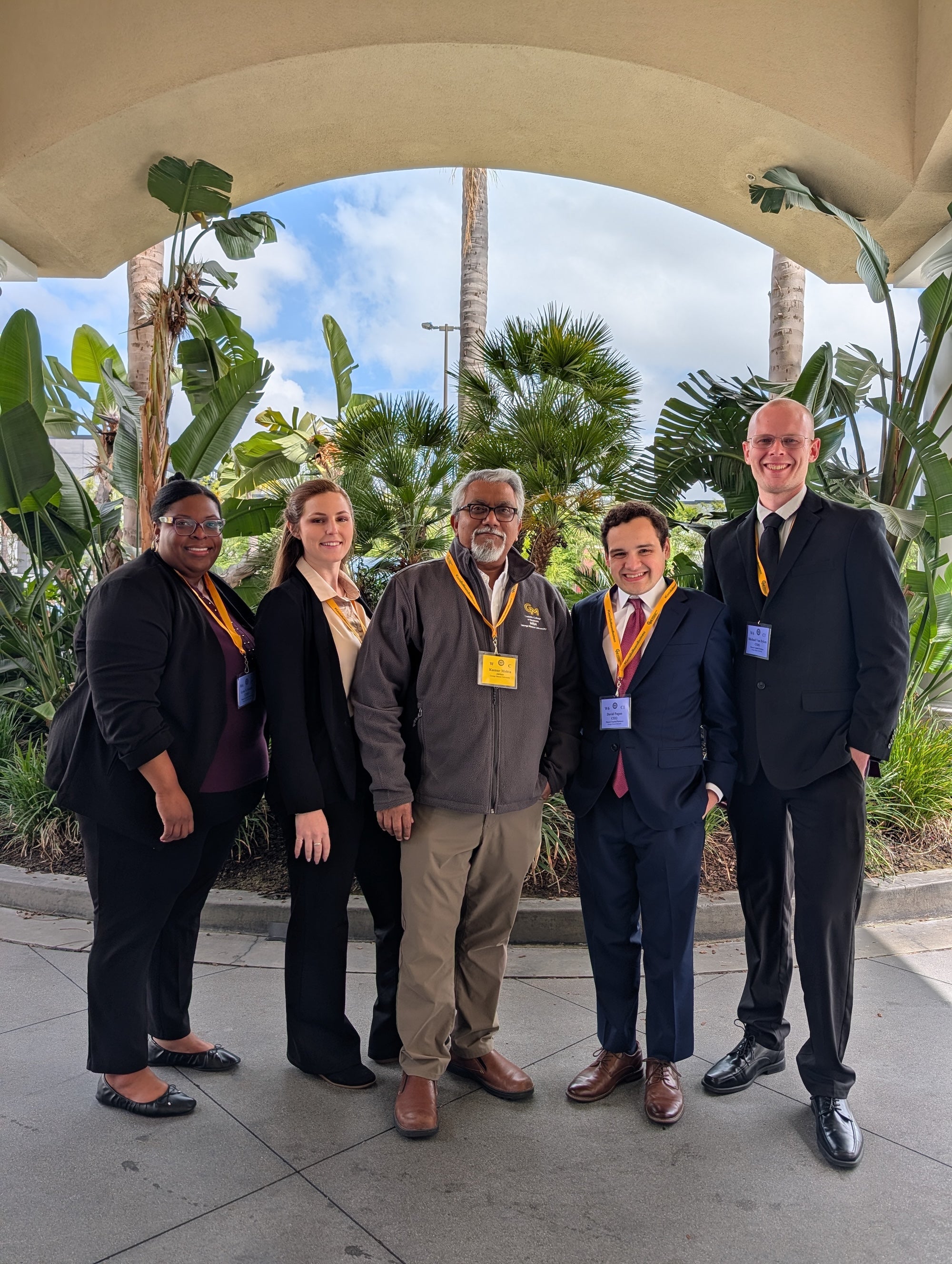
(left to right): Lyne Joseph, Victoria Holtzman, Kumar Mehta, David Pagan, and Mike Van Dyken. Photo courtesy by Costello Graduate Case Competition Team.
After applying, interviewing, and being accepted, the Costello graduate case competition team—Mike Van Dyken, an MS in Business Analytics (MSBA) student; Victoria Holtzman, an MS in Real Estate Development (MRED) student; Lyne Joseph, an MBA student; and David Pagan, an MBA student—banded together for two competitions during the 2025-2026 academic year.
First up was the Kogod Case Competition at American University, a rigorous two-round event that ran from October 2025 through mid-February 2026, where the team proudly advanced as finalists. At the same time as this effort, the team also took on the International Collegiate Business Strategy Competition (ICBSC), starting in January and running through April 2026, where they won top recognition in the Best Reports to the Board of Directors category.
“Taking on the roles as a C-suite of a simulated global company is a massive challenge, but the synergy between our MBA, MSBA, and MRED students proved that intellectual diversity is a phenomenal strategic advantage. They truly owned the process, navigating a grueling gauntlet of executive decisions with incredible perseverance.”
— Kumar Mehta, instructional associate professor, information systems and operations management
Personal time was put on hold as the students, who balanced these demands alongside full-time jobs and heavy graduate coursework, spent long days and nights meeting critical deadlines. Navigating both competitions simultaneously meant there was overlap between the projects, increasing the stress even more.
For the Kogod Competition, American University partnering with LinkedIn, provided them a prompt themed around “Designing the Future of Work and AI.” The competition challenged 50 student teams to use real-world data to craft and present strategic solutions to business executives. The ICBSC provided them with a challenging setup requiring them to manage a simulated manufacturing company in a globalized economy, making quarterly strategic executive decisions in marketing, finance, human resources, and operations over a span of several virtual years.
“When we did the first competition, we were very new, still getting to know each other and trying to figure out how it worked as a team,” says Joseph. Their teamwork paid off as they took home the award for their report. “I have done a few case competitions, and I think that this one takes the cake for time intensity and for just the complicated matter of having to be a jack of all trades,” says Holtzman.
The team got used to making multiple business decisions for their simulated company on a weekly basis, and then, in person for the final event, they made complex quarterly decisions every few hours. “Being able to get that back-and-forth with financial professionals is something that I think was the most valuable part for me,” says Van Dyken.
The Costello College of Business wholeheartedly supported the team by fully sponsoring the undertaking. Beyond this financial backing, the students benefited from a comprehensive support system arranged by the MBA Program. Alongside mentoring from their faculty advisor, Kumar Mehta, the team received coaching for executive presence and presentation skills, technical assistance from the instructional design team, and strategic insights from subject matter experts.
Mehta highlighted the unique strength of their collaboration. “Taking on the roles as a C-suite of a simulated global company is a massive challenge, but the synergy between our MBA, MSBA, and MRED students proved that intellectual diversity is a phenomenal strategic advantage. They truly owned the process, navigating a grueling gauntlet of executive decisions with incredible perseverance.” he says.
Although each member had a defined role, they worked collaboratively on every aspect of their simulated business, from marketing and hiring to financing and production. “Being in a competition with this group of people has been just an amazing experience,” says Pagan. “And I am glad that we all did it voluntarily rather than having it be for a grade, because you get some of the most incredible, most motivated people in the entire business school on one team, doing it for the sake of the competition, for learning and having a new experience that you know will be something you can take with you for the rest of your career.”
Taking their business education beyond the classroom, these students have sharpened their skills and built the confidence to make critical decisions when it matters most in their future careers.