Connected DMV has announced that George Mason University, one of the nation’s most innovative and fastest-growing public research universities, will serve as the Lead Academic Partner for spaceNEXT, the inaugural global convening focused on the commercialization of space and a flagship program of Connected DMV’s Potomac Center for the New Space Economy.
The spaceNEXT event will take place February 18–20 at Capital One Hall in Tysons, Virginia, and bring together global leaders across industry, government, academia, and the investment community to accelerate what’s next in the space-for-space and space-for-Earth economy.
“George Mason is the ideal academic anchor for spaceNEXT. Their leadership in space science, satellite engineering, and frontier research perfectly aligns with our mission to build Greater Washington into the global capital of the new space economy,” said George Thomas, president and CEO, Connected DMV. “This partnership brings world-class expertise, talent, and innovation to the main stage, and we couldn’t be prouder to shape this inaugural event together.”
George Mason’s collaborative and creative research strengths align directly with the new space economy
Advancing space innovation that serves life on Earth—through Earth observation, remote sensing, planetary exploration, and space weather research—is a core focus of George Mason’s Grand Challenge Initiative, which aligns research, education, and partnerships around solving problems that shape the future of humanity. The university’s growing strengths in robotics and autonomy, artificial intelligence, quantum science, integrated sensing and communication, and sustainable cyberinfrastructure—anchored by Fuse at Mason Square—support next-generation capabilities such as autonomous spacecraft operations, in-space servicing, on-orbit manufacturing, and resilient space infrastructure that connect scientific discovery to real-world impact.
“Our future in space is a key component to solving humanity’s grand challenge of creating a peaceful, healthy, and prosperous future,” said Andre Marshall, vice president for research, innovation, and economic impact. “George Mason is forging strategic partnerships and driving novel research across disciplinary boundaries to help shape and secure this bold future, recognizing that it will reach far beyond the Earth’s atmosphere, and we are proud to partner with Connected DMV to further these ambitious goals.”
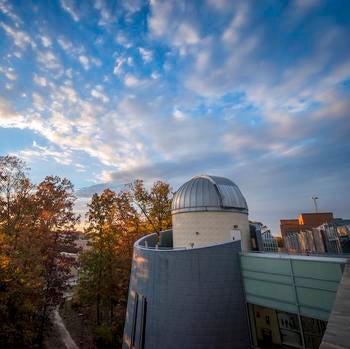
The George Mason College of Science’s multi-million-dollar portfolio in Earth- and space-observation research gives the university the region’s strongest capabilities in satellite data, remote sensing, and climate-driven analytics. Home to the Center for Earth Observing and Spatial Research, the Satellite and Earth System Studies Program, the Center for Geospatial Intelligence, and the second largest observatory on the East Coast, the College of Science maintains research collaborations with NASA, NRL, Department of Energy, Defense Threat Reduction Agency, Air Force Office of Scientific Research, and the Army Research Office, as well as a recent $13M collaboration with the Department of the Navy to study increased solar activity. These fields underpin the expanding market for commercial Earth intelligence, environmental monitoring, and mission-critical geospatial tools, while offering immersive training for tomorrow’s scientists and regional workforce.
"The future of space commercialization will be driven by institutions like George Mason that can bridge scientific discovery, facilitate industry collaboration, and drive real-world innovation,” said College of Science dean Cody W. Edwards. “For years, we have invested in the research, facilities, and workforce development infrastructure to become a valued partner in the emerging space economy. We look forward to bringing George Mason’s research, talent, and entrepreneurial spirit to this global convening—and to helping chart the course for the next era of space exploration and economic growth in the region and beyond.”
George Mason’s College of Engineering and Computing is also a regional leader in workforce development for the new space economy. Its graduate Small Satellite Engineering program trains engineers in full spacecraft lifecycles—including design, power, communications, sensors, attitude control, and resilient architectures—while the university’s CubeSat Engineering Lab and satellite ground stations (including a 9.1-meter dish) provide students and researchers hands-on experience with small satellite buses, flight systems, and embedded software hardened for the realities of space.
“We find solutions to problems in aerospace engineering that advance the field,” said Kenneth Ball, College of Engineering and Science dean. “Our researchers make air travel safer, satellites smaller, and surfaces stronger. Our students learn to fly airplanes, launch satellites, and explore the multidisciplinary nature of aerospace and aviation from the capabilities of materials to the possibilities of space. Our alumni have traveled in space, driven the Mars rover, and held leadership positions at NASA.”
As part of its powerful portfolio, the university is leading the $19.5 million NASA Landolt Space Mission, which will place an artificial “star” into orbit to calibrate telescopes and significantly advance the precision of space-based observations—unlocking new discovery pathways and supporting commercial applications across astronomy, imaging, quantum materials, space weather, and navigation.
Advancing the mission of the Potomac Center for the New Space Economy
spaceNEXT is a core program of the Potomac Center for the New Space Economy, Connected DMV’s initiative to position the Washington, D.C., region as the heart of the global space economy. The center leverages the region’s unparalleled mix of assets—federal space agencies, aerospace giants, venture investment, world-class universities, national security infrastructure, and diplomatic reach—to build the partnerships, standards, workforce, and innovation pathways that will shape humanity’s next giant leap.
With George Mason at the helm of the academic program for spaceNEXT, the center strengthens its ability to:
-
Showcase regional leadership in orbital manufacturing, microgravity research, and logistics;
-
Bridge federal space policy with the commercial and investment momentum driving new markets;
-
Catalyze workforce growth through academic pipelines deeply tied to industry demand;
-
Accelerate commercialization of frontier technologies across satellites, AI, autonomy, Earth intelligence, and in-space services; and
-
Unite the region’s public, private, academic, and policy talent under one global platform.
George Mason’s expertise and programs embody the center’s mission: Turn bold ideas into market-shaping realities and ensure that the Washington, D.C., region captures a decisive share of the growing space economy—projected to top $1 trillion by 2040.
A launchpad for the next space economy
With George Mason University as Lead Academic Partner, the inaugural spaceNEXT convening will demonstrate how universities, industry, and government can work together to accelerate the space-for-space and space-for-Earth economy—advancing national security, scientific breakthroughs, economic growth, and human progress on a global scale.
Learn more at spacenextglobal.com.

Related Stories
- July 17, 2026
- July 9, 2026
- May 8, 2026
- May 7, 2026
- May 6, 2026