In This Story
Instead of viewing the rapid rise of artificial intelligence as a threat to people, what if we considered it a mirror—one that helps clarify and strengthen what is distinctly human about organizational collaboration?
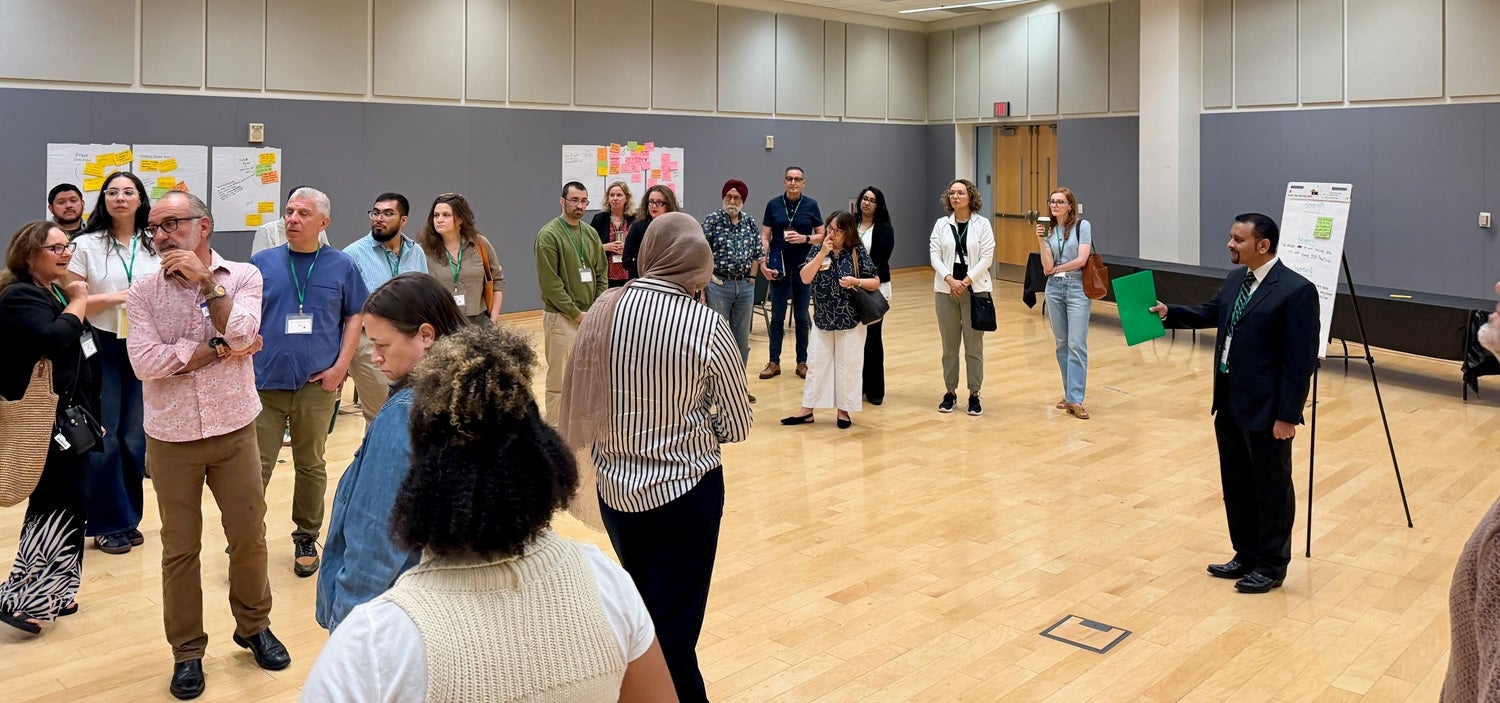
That was the question some 90 attendees addressed during a day-ong workshop hosted by the Schar School of Policy and Government’s Organization Development and Knowledge Management (ODKM) Cohort 30 during its fall semester learning community, held September 12 at Mason Square’s Van Metre Hall.
The attendees included faculty, graduate students, alumni, and industry leaders who were drawn by the event’s title, “Reauthoring the Team: Relational Intelligence in the Age of AI.”
The program opened with experiential learning activities including “The Invisible Colleague” and an “AI SWOT” exercise that were designed to surface assumptions about AI team members and identify core human values. SWOT stands for strengths, weaknesses, opportunities, and threats, all things to consider when connecting with AI.
Appearing via video link from California, keynote speaker Isabelle Hau, executive director of the Stanford Accelerator for Learning, set the theoretical foundation by championing “augmentation over automation” and framing “relational infrastructure” as an essential requirement for organizational flourishing in an algorithmic age.
The student-designed event was a response to the rapid emergence of AI and the turbulence it is causing as it ripples through every aspect of society.
“Every day we hear about AI and how it will supplant work we do now,” said Penny Potter, and instructor in the ODKM program. “Often overlooked are what opportunities this disruption offers.”
The event, she said, “gave participants the opportunity to explore relational intelligence as a key capability that serves as connective tissue in organizations.”
Participant Erin Finn, a 2024 graduate of the ODKM program, summed up the workshop experience: “It made the whole conversation about AI feel like such a natural fit for this [leadership] community and for how we might think about moving into this new era—without losing the human part of the work.”
A multidisciplinary practitioner panel featuring psychologist Kinga Mnich, organizational health strategist Judy Oyedele, Department of Defense lead knowledge management specialist Lavdjola Farrington, and leadership development professional Jason Drake grounded these concepts in practical applications spanning social psychology, executive coaching, defense knowledge governance, and public sector leadership.
In the afternoon, participants engaged in three rounds of a “1-4-All Knowledge Café.” Guided by Harvard’s Marshall Ganz's public narrative framework (Story of Self, Us, and Now) and Harvard’s John Kotter’s eight-step change model, attendees moved from individual reflection to table dialogue and room-wide synthesis.
The activation concluded with a compelling call to action led by student facilitators and supported by ODKM founding Director Tojo Thatchenkery and Potter.
Attendees were challenged with the final prompt, “What will you do differently on Monday?,” urging leaders to actively author their teams’ relational dynamics rather than allowing technology to define them by default.
The day’s activities concluded with a call to action for every leader in the room: “If you do not step up and consciously author your team’s story, the technology or the hierarchy will do it for you.”
Costello College of Business instructional associate professor Jeremy E. Plotnick contributed to this report.