
In This Story
When Cheyenne Bajani arrived at George Mason University, she didn't know that an introductory embedded systems course would help launch her into one of the world's leading semiconductor companies.
The computer engineering graduate applied the skills she developed at George Mason to a summer internship with Micron, an industry leader in memory and storage solutions, through the Virginia Microelectronics Consortium (VMEC) summer scholars program. VMEC connects students across Virginia’s colleges and universities with academic and industry partners.
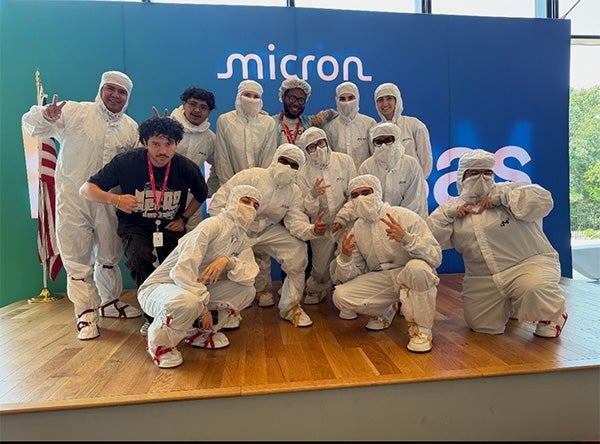
For Bajani, the internship represents an opportunity to contribute to a rapidly evolving industry. “Micron is leading a big change that's happening in the world,” Bajani said. “It manufactures the hardware on which AI sits. It's also the first step in the supply chain, and I can't imagine a world where this kind of hardware wouldn't be needed.
“Every second counts, and iteration never stops in the pursuit of optimization; it's engineering at its best.”
Her journey toward the semiconductor industry began during her sophomore year at George Mason, when she enrolled in Intro to Embedded Systems, taught by Professor Pelin Kurtay in the Department of Electrical and Computer Engineering (ECE). Drawn to the course's hands-on approach, Bajani discovered a passion for working with microprocessors and went on to take three embedded systems electives.
“Microprocessors are small boards, a mini version of the brain of your computer,” Bajani said. “You can use this brain to do pretty much whatever you want and use it to solve bigger problems.”
Embedded systems work by using sensors to collect information from the environment, which is then processed by a microprocessor, Bajani said. The sensor sends this data to a microprocessor, which acts as the “brain” of the system. The microprocessor is programmed to interpret the sensor’s data and communicate the results to the larger system and its other components.
The skills she developed at George Mason helped her succeed at Micron. During her three-month internship, Bajani worked in the chip-testing department, where teams evaluate memory wafers produced during manufacturing. By improving testing efficiency, Micron can maximize productivity and ensure product quality.
“It’s also a really good environment to work in,” Bajani said.
Beyond the classroom, Bajani built leadership experience through active involvement in student organizations. She served as treasurer of the Society of Women Engineers, vice president of the Lebanese Student Organization, a CEC peer mentor, and an engineering learning assistant.
Her classroom and leadership experiences culminated in a standout senior design project. Bajani and her teammates designed a brain-controlled wheelchair that helps people with limited mobility navigate places independently. They won second place overall in the ECE capstone competition.
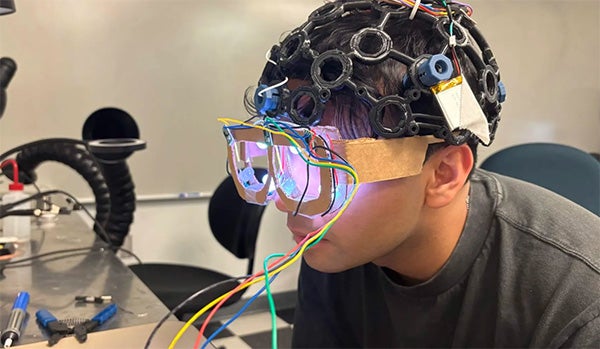
“We built glasses that the person wears, and then these glasses have lights that flash at different speeds,” Bajani said. The system uses visual signals to guide movement commands while allowing users to continue everyday activities without interruption. Designed for portability, the wheelchair incorporates both the wearable glasses and a control system mounted directly to the chair.
Looking back, Bajani credits George Mason's diverse community, challenging curriculum, and professional opportunities, shaping her academic and personal growth.
She encourages students to take advantage of the opportunities available to them.
Doing so, she said, may change their lives.