
In This Story
Eventful barely describes Meghan Garrity’s summer. The assistant professor in the Schar School of Policy and Government had her first book, Mass Expulsion: The Politics of Forced Population Removal, published by Oxford University Press in July.
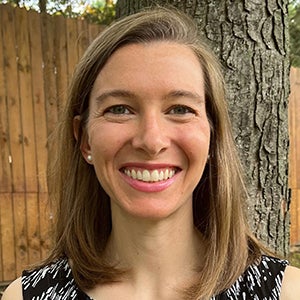
The month before, she began serving as a Genocide and Atrocity Prevention Research Fellow in the Simon-Skjodt Center for the Prevention of Genocide at the United States Holocaust Museum.
“There’s a lot going on, but all good things,” she said.
Garrity joined the Schar School in 2023 and teaches in both the undergraduate International Security and Law and the Master of International Security programs. She earned the school’s Don Lavoie Teaching Award in 2025. Her research centers on international peace and security, ethnic violence, and forced migration.
“Within political science sometimes those fields are siloed and so I try to bring those strands together in my research which hopefully speaks to the Schar School’s broad interest in international security,” she said. “I’m more focused on the human security effects and consequences of various forms of violence that happen.”
Garrity’s book examines why and how governments expel, providing a systematic, cross-regional account of mass expulsion from 1900–2020. Drawing on her original Government-Sponsored Mass Expulsion (GSME) dataset, she explains when and where expulsion occurs, who is targeted, and what regimes are most likely to expel.
“I write in the book that it’s a rare event but it’s a recurring rare event,” she said of mass expulsion. “That’s one of the main reasons that it’s an important topic to study. People are still being affected by these policies. We still have more work to do to reduce or minimize their occurrence.”
Garrity’s yearlong fellowship through the U.S. Holocaust Museum is intended to support new or ongoing original research projects on mass atrocities and/or mass atrocity prevention. She proposed her next book project as the topic for the fellowship, which will examine why governments choose various policies of elimination to get rid of different groups such as genocide, expulsion, or erasure of identity by forced cultural assimilation.
“I will try to identify the conditions under which governments would choose different policies like that,” she said.
She received $30,000 for the award, which she is using to take time away from teaching this fall and affords a lighter schedule in the spring.
“Especially starting a new project, you really need time to survey the literature and read deeply,” she said. “The fellowship is really generous and hands off, just giving the resources to be able to work on your research. It’s such a gift to have some additional time.”
While Garrity’s colleagues and students will miss seeing as much of her in the classroom this year, it is important for faculty to have opportunities to advance their research. Garrity’s fellowship and emerging work will contribute to scholarship at the Schar School and to a broader understanding of urgent global challenges.