
In This Story
George Mason University’s College of Engineering and Computing (CEC) was well represented at the American Society for Engineering Education (ASEE) Annual Conference in Charlotte, NC in June. CEC faculty and staff members presented papers and talks, won awards, staffed a booth in an expansive exhibit hall, and were elected to ASEE leadership positions.
The conference is the only cross-discipline engineering education conference in the U.S. and Canada and gives CEC faculty a chance network with colleagues, lead sessions, publish papers, and share best practices.
The college’s exhibit hall presence attracted numerous attendees. The booth featured a boardgame themed around CEC's 40th anniversary that visitors enjoyed playing. In addition, with a unique, gel-filled stress cube, the CEC booth unofficially had the most popular “swag” item of all exhibitors.
Among the notable George Mason-related activities at the conference:
Dean Ken Ball was made an ASEE Fellow; CEC co-sponsored the Awards Lunch where he was recognized.
Chris Carr, associate dean and deputy Title IX Coordinator, Office of Outreach, Student Success, and Engagement, who served on the ASEE Board as chair of Professional Interest Council (PIC) I at the start of the conference, was elevated to VP of PIC chairs and was then selected by the board to serve as First Vice President. He also presented at the workshop, “Leveraging Global Engagement Programs for Women’s Leadership Development.”
Liling Huang, associate professor, Department of Electrical and Computer Engineering, had four conference papers and presentations. One of her papers, "Advancing Clean Energy Education through a Small Modular Reactor Simulator and Cross-Sector Collaboration," won the Best Paper Award in the Energy Conversion, Conservation and Nuclear Engineering Division.
Aditya Johri, a professor in the Department of Information Sciences and Technology, led sessions on the use of Generative AI by doctoral students and on teaching and learning using generative AI. With three doctoral students, he presented posters related to three National Science Foundation (NSF) awards, all on AI literacy and education.
Leigh McCue, chair of the Department of Mechanical Engineering, had a paper titled, “Reconciling Innovation and Safety for Additive Manufacturing in Academia.”
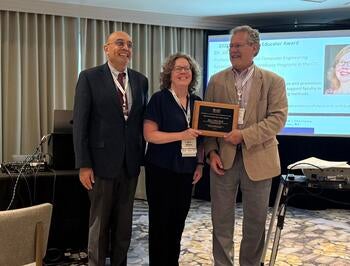
Jill Nelson, associate dean for undergraduate programs, won the Electrical and Computer Engineering Division Distinguished Educator Award. She also facilitated a roundtable on “Career Stages and Professional Transitions.”
Kammy Sanghera, executive director, global engagements and tech talent development, presented a paper on “Building Bridges in Global Engineering Education” to the Global Engineering Dean’s Council.
Ioulia Rytikova, professor and associate chair for academic excellence, presented the paper, "Framework to Redesign Cognitive Presence in Accelerated Asynchronous Online STEM Courses: A Case Study."
Janis Terpenny, a professor in the Department of Systems Engineering and Operations Research and Department of Mechanical Engineering, received the 2026 David Wells Service Award from the Manufacturing Division. She also participated in a discussion on strategic strategies and planning focused on the future of manufacturing education with representatives from ASEE, the American Society of Mechanical Engineers, and the Society of Manufacturing Engineers. She presented at an NSF panel on “Opportunities in Manufacturing Education.”