
David Harrison, Senior Vice President of Operations at Sabel Systems, and a longtime partner of the George Mason University Honors College, has been named the inaugural recipient of the Honors College Community Champion Award at the Spring Research Exhibition and Awards Ceremony on May 1, 2026.
Presented for the first time in Spring 2026, the Honors College Community Champion Award recognizes individuals from the Honors College’s extended community who have made a sustained impact and demonstrated a commitment to the Honors College and its students.
Since 2018, Harrison has served as a project sponsor and primary partner liaison for eight student teams in HNRS 360 Honors College Consults, and has been involved in one more — supporting a total of 41 Honors College students across nine projects. In the course, multidisciplinary teams of Honors College students take on strategic challenges posed by partner organizations from the public, private, and nonprofit sectors.
Harrison has carried this work with him across three different jobs at three different companies, previously partnering with the Honors College as Vice President of Enterprise Services at QinetiQ and as Operations Director for the Office of the Chief Information Officer at Northrop Grumman. Harrison explains his ongoing connection, saying “engaging with Honors College students is consistently energizing—their perspectives are fresh, and their work often directly addresses real business challenges.”
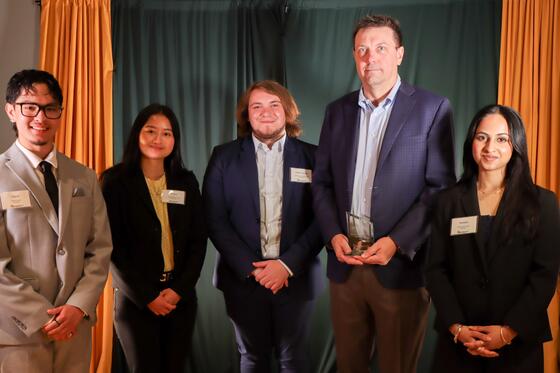
Andy Hoefer, associate dean for student engagement, admissions, and administration in the Honors College describes what makes Harrison so valuable for the students: “David challenges students with problems that are big, real, and full of ambiguity, but he supports them with warmth, humor, and sincere enthusiasm for their ideas and insights,” Hoefer said. Harrison says his approach to the students is grounded in showing them who he really is as a professional: “I try to show up as my most authentic, inclusive self, hoping they'll carry some of that with them as they begin their careers.”
This approach to working with students reflects the kind of learning the Honors College is built around — students from every major work together to ask better questions, consider issues from multiple perspectives, and evaluate evidence in context.
“David is an obvious choice for this recognition,” said Andy Hoefer, associate dean for student engagement, admissions, and administration in the Honors College. “Even above faculty members, he has been the most consistent presence in HNRS 360 Honors College Consults since the course began eight years ago.”
As Hoefer put it, “Where David goes, opportunities for Honors College students follow.”