
As the university’s Grand Challenge Initiative (GCI) enters its second year, George Mason University recently announced funding for seven catalyst research projects and the launch of the Grand Challenge Research Exchange—quarterly convenings for all GCI-related research to accelerate solutions to the grand challenge of our time. The Costello College of Business is a participant in the initiative and collaborating in three of the seven new catalyst projects.
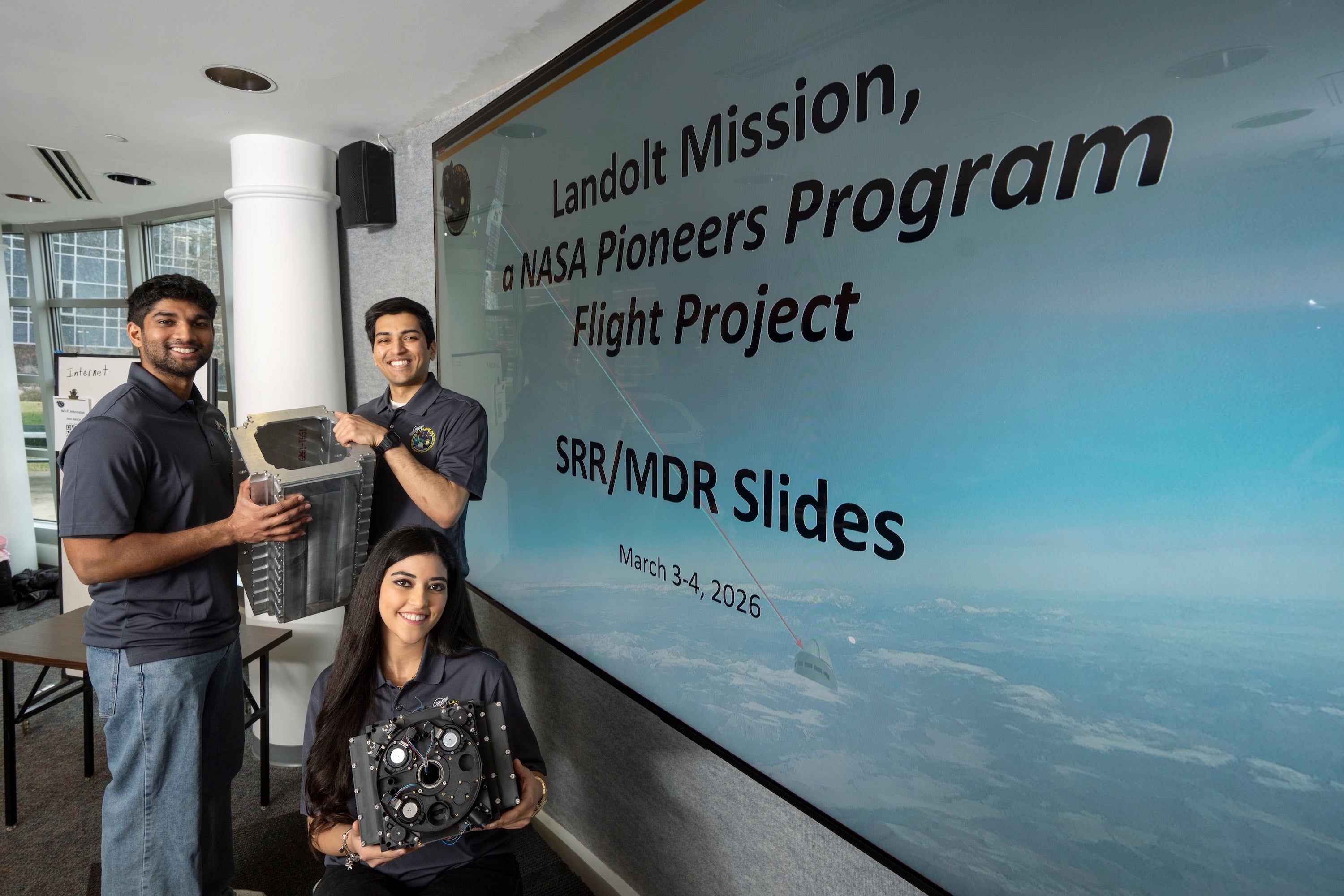
Photo by the Office of University of Branding.
“We have placed our first bets on building a better future for humanity,” said President Gregory Washington. “These awards represent the very best of George Mason faculty research. They sit at a crossroads where the world’s greatest problems meet our faculty’s greatest research strengths to solve them. At a time when the world’s greatest challenges can appear to be winning, today the smart money is on George Mason professors.”
“Driving bold solutions to a changing world requires an interdisciplinary approach that includes multiple perspectives and knowledge from many fields of study,” notes Cheryl Druehl, Costello College of Business interim dean. “When viewed through a business lens, solutions are likely to include a sharp focus on customer and end-user needs, collaboration with business and industry, and fit with local regulations and preferences to increase the likelihood of their adoption.”
Costello College of Business projects, in collaboration with the College of Science, Schar School of Policy and Government, College of Humanities and Social Sciences, College of Engineering and Computing, and College of Education and Human Development and participating faculty include:
-
George Mason University Space Center
-
George Mason’s Quantum Leap
-
AI-Powered Human Rights Education for All
JK Aier, senior associate dean for academic affairs and global engagement, will bring his expertise to the George Mason University Space Center to collaborate on new degrees in business, planetary science, aerospace engineering, space policy and law, space program management, and space AI, as well as bringing current courses under the same umbrella. He will also help facilitate partnerships with space businesses, organizations, governmental agencies, and other space initiatives locally, nationally and internationally, through Costello College of Business centers of excellence like the Greg and Camille Baroni Center for Government Contracting, as well as global partner institutions. "The Costello College of Business is excited to bring a business-oriented point of view to this collaborative interdisciplinary approach to space research and education,” says JK Aier. “Our role in helping to accelerate solutions to the grand challenge speaks to the centrality of business education in our careers, our lives, and the world in which we live.”

Photo by the Office of University of Branding.
Designing and launching small satellites, and generating data to improve climate forecasting, disaster preparation, infrastructure protection, and scientific discovery, the new space center will position the university as a leader in using space technology to solve real-world problems. It will create a sustainable external funding campaign by continuously engaging with space businesses, organizations, governmental agencies, and other space initiatives locally, nationally, and internationally.
Jiasun Li, Robert D. Johnston associate professor of finance, has joined the leadership team for George Mason’s Quantum Leap project, utilizing his expertise in blockchain and emerging technologies in finance to position George Mason as a leader in next generation computing. His work will engage the regional quantum ecosystem, accelerate quantum economic growth across the Commonwealth, and create executive and continuing education for industry leaders that demystifies quantum computing and highlights its business value in this fast-moving field.
Lei Gao, associate professor of finance, brings a unique interdisciplinary background in computer science, industrial math, and business to the AI-Powered Human Rights Education for All project, where he will create an AI-driven virtual human rights classroom prototype. The classroom would be accessible to people everywhere and will help them to learn and apply human rights principles in their day-to-day lives. Gao will identify and define the critical intersections between human rights and business for the prototype’s content, ensuring that both the prototype and the Human Rights Impact Assessment (HRIA) components meaningfully address business and human rights considerations. The prototype will be tested in the business courses he teaches: FNAN 444 and FNAN 483/MSF 638.
The new seven catalyst projects were selected from 41 proposals, with more than 75 PIs, submitted across every college and school at George Mason, including Mason Korea. More than 35 external partner organizations were represented across submissions; 38 were transdisciplinary, and six involved five or more colleges working together.
“George Mason's institutional investment underscores our commitment to high-impact, interdisciplinary mission-driven research,” said Andre Marshall, vice president for research, innovation, and economic impact. “GCI positions research to build our enterprise and engage additional funders to deliver real-world change.”
To support all GCI-related research, including the 41-proposal cohort, through stages of development, George Mason is launching new quarterly convenings called the Grand Challenge Research Exchange. The first convening will launch this fall. Designed in partnership with the three Office of Research, Innovation, and Economic Impact (ORIEI) Institutes and Mason Now team, these exchanges will feature industry keynotes, expert guest lecturers, and professional development workshops about leadership development, strategic planning, financial and program management, funding support, proposal and partnership development, and community engagements models.
George Mason’s Grand Challenge Initiative is a five-year campus wide initiative with an initial $15 million investment to mobilize interdisciplinary expertise and drive bold solutions for a changing world. The six solutions are advancing 21st-century education; building a climate-resilient society; driving responsible digital innovation and sustainable infrastructure; improving human health, well-being, and preparedness; pioneering space exploration; and strengthening peace, trust, and engagement in democracy. GCI will fund more than 20 solutions-based catalyst research projects over the next four years.
To learn more about how the Costello College of Business is advancing bold solutions, visit business.gmu.edu or gmu.edu/research/grandchallenge.