Entrepreneurship is rapidly reshaping the economic landscape of West Asia, particularly in Saudi Arabia, the United Arab Emirates, and Qatar where governments are actively transitioning away from oil dependence toward diversified, innovation-driven economies.
At the center of this transformation is Saudi Arabia’s Vision 2030, a strategic framework designed to expand private sector participation, empower small and medium-sized enterprises (SMEs), and position the Kingdom for sustainable, long-term growth. The Vision 2030 goals include increasing SME contribution to GDP from 20 percent to 35 percent.
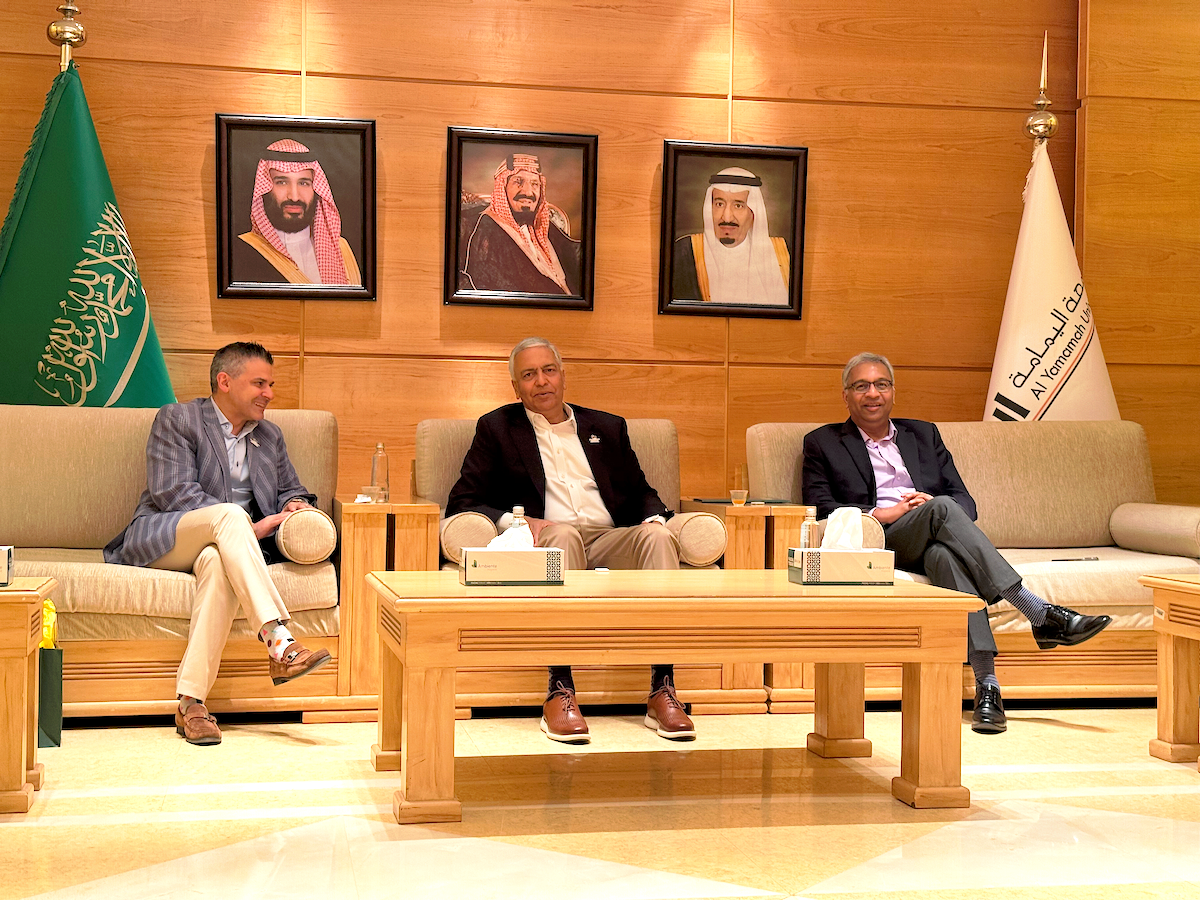
Costello College of Business at George Mason University Associate Dean for Outreach and Strategic Engagement Patrick Soleymani, Costello College of Business Dean Ajay Vinzé, and Costello College of Business Senior Associate Dean for Academic Affairs and Global Engagement JK Aier on a recent trip to Saudi Arabia, where they met with government officials to discuss opportunities for bridging the gap between academic research and entrepreneurship in the Kingdom. Photo courtesy of Patrick Soleymani.
SMEs play a critical role in driving innovation, employment, and economic diversification, and the region is already seeing impressive results. Saudi Arabia’s economic transformation accelerated in 2025, with the non-oil economy reaching approximately 55 percent of GDP and the private sector contributing 51 percent, according to the Saudi Vision 2030 Annual Report. “Financing to SMEs reached 11.3 percent, exceeding the annual target. SME employment reached over 8 million, exceeding the 2027 target,” states the report.
Further, Saudi Arabia achieved a record total Venture Capital (VC) deployment of SAR3.2 billion ($860 million) in the first half of 2025, up by 116 percent compared to that same timeframe 2024, surpassing the total VC funding for all of 2024, according to Middle East Economy. “‘The steady growth of the Saudi VC ecosystem in recent years has enabled it to maintain its leading position in the MENA region,’” said Dr. Nabeel Koshak, CEO and board member at SVC as quoted to Middle East Economy. “‘This growth directly results from the country’s commitment to realizing the Saudi Vision 2030, which emphasizes fostering entrepreneurship and stimulating investment in startups from early to later stages.’”
“What we are seeing in West Asia is a masterclass in intentional eco-system building…”
— Patrick Soleymani, associate dean for outreach and strategic engagement at the Costello College of Business at George Mason University
The Kingdom of Saudi Arabia’s capital, Riyadh, climbed significantly in international startup rankings, reflecting improvements in infrastructure, funding availability, and regulatory frameworks. Riyadh advanced 60 places over the past three years to rank 23rd among the top 100 emerging startup ecosystems globally in the "Global Startup Ecosystem Report 2025," published by Startup Genome in partnership with the Global Entrepreneurship Network.
This growth is driven in large part by strong government support, particularly through the Small and Medium Enterprises General Authority (Monsha’at), notes the Saudi Press Agency (SPA). Monsha’at develops programs and initiatives that enable startups to grow and scale, while helping to improve the regulatory and legislative landscape for entrepreneurs. Together, these efforts are designed to expand the sector’s contribution to GDP, aligning with the broader objectives of Saudi Arabia’s Vision 2030.
Saudi Arabia’s startup ecosystem has experienced substantial expansion, with growth exceeding 200 percent in recent years, according to the Global Startup Ecosystem Index 2025. “Saudi Arabia's startup ecosystem is ranked #38 worldwide, climbing 27 spots compared to the previous year. The Saudi startup ecosystem ranks 3rd in the Middle East.”
In heralding the increasing number of SMEs, the Vision 2030 Annual Report states “This has been supported by improvements in the SME ecosystem and access to finance, including expanded incubators and accelerators, increased support for entrepreneurs, and stronger financing channels through institutions such as the SME Bank.” The report specifically notes the SME Bank’s expanded lending capacity along with a “wider use of fintech solutions and risk-sharing programs. Progress continued in 2025, with expanded support for entrepreneurs through accelerators, incubators, and coworking spaces.”
The United Arab Emirates (UAE) ranked first in the Global Economic Monitor (GEM) report’s National Entrepreneurship Context Index (NECI) for the fifth consecutive year. Qatar has historically ranked among the top 10 in the NECI and continues to be recognized alongside other high-income Gulf economies like the UAE and Saudia Arabia as strong and supportive entrepreneurial environments.
The entrepreneurial momentum unfolding across West Asia mirrors a broader global reality that institutions like the Donald G. Costello College of Business at George Mason University have long embraced: entrepreneurship is not simply a business activity—it is a vehicle for economic and social transformation. At Costello, that conviction is embedded in everything from the Center for Innovation and Entrepreneurship's experiential programs, including the Patriot Pitch Competition and the Patriot Ventures Program, to the SOAR Initiative, which delivers hands-on entrepreneurship training to members in the Washington, D.C., region.
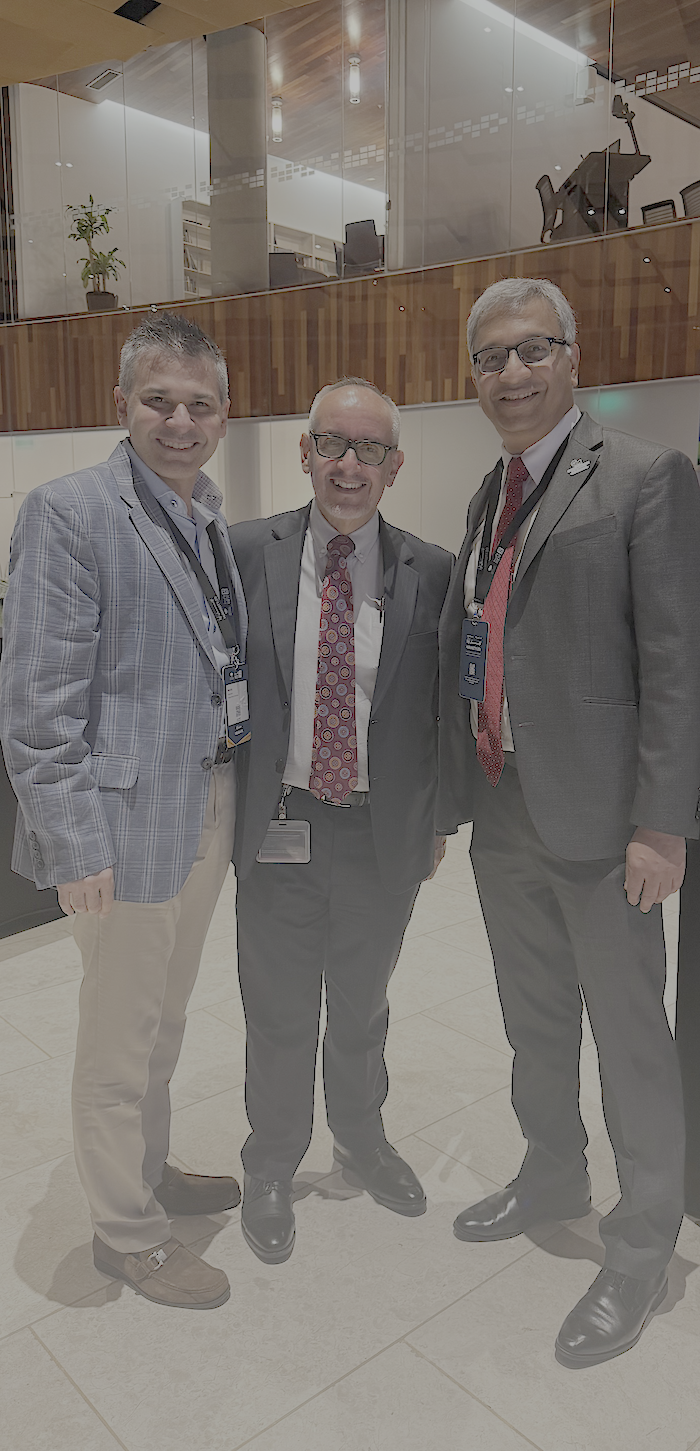
Costello’s Patrick Soleymani and JK Aier meet with Francisco Marmalejo, President of Higher Education at Qatar Foundation (center), for discussions on how George Mason University is helping to develop entrepreneurial ecosystems that are adaptable, inclusive, productive, and sustainable. Photo courtesy of Patrick Soleymani.
The parallels to what is happening in Saudi Arabia, the UAE, and Qatar are striking—both reflect the understanding that building a robust entrepreneurial ecosystem requires more than capital; it demands deliberate investment in education, mentorship, and inclusive access to opportunity. "What we are seeing in West Asia is a masterclass in intentional ecosystem-building," said Patrick Soleymani, associate dean for outreach and strategic engagement and associate professor of management at the Costello College of Business. "When governments, institutions, and communities align around entrepreneurship as a strategic priority—removing barriers, expanding access to financing, and cultivating a culture of innovation—the results speak for themselves. That is exactly the model we champion at Costello, and it is exciting to see it driving transformation on a global scale."
Entrepreneurship is becoming a central pillar of economic transformation in West Asia. Government-led reforms, strong capital flows, and a digitally enabled population are converging to create one of the world’s fastest-growing startup ecosystems. Business leaders who understand both the opportunities and constraints shaping entrepreneurship in the region will better position themselves to succeed in an increasingly competitive global economy.