
In This Story
George Mason University’s Systems Engineering and Operations Research Department (SEOR) assumed a leadership role in the global systems engineering community this spring by hosting one of the field’s premier research conferences at Fuse.
The Conference on Systems Engineering Research (CSER) established in 2003 aims to advance the boundaries of systems engineering through academic research, with the purpose of expanding the field’s scope to one of research and practice. The conference bridges the gap between theoretical research and evolving needs of large-scale, safety-critical industries such as aerospace, defense, automotive, and healthcare.
For more than two decades, CSER has convened almost exclusively at its founding institutions—the University of Southern California and Stevens Institute of Technology. This year, SEOR faculty led a successful effort to hold the conference at George Mason, signaling the department’s growing influence in systems engineering research.
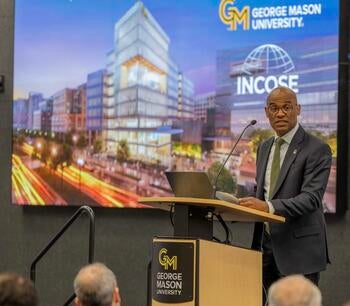
“Hosting CSER 2026 underscores George Mason’s leadership in systems engineering and digital engineering,” said Ali Raz, a SEOR assistant professor, who worked with Professor John Shortle to bring the conference to George Mason, with support from the International Council on Systems Engineering (INOCSE). Under SEOR’s leadership, CSER drew 180 participants from four continents, reinforcing George Mason’s position as a global convening hub for systems engineering research.
“The conference theme was ‘Intelligent Digital Twins for 21st Century Socio-Technical Systems,’ which in part reflects the contribution SEOR is bringing to the world in both academics and research,” said Raz. SEOR professors Abbas Zaidi, Matthew Amissah and Lance Sherry also assisted in organizing the conference.
SEOR chair Guiping Hu said, “By organizing and hosting CSER, our department didn’t just support the field, we helped lead it. The energy at the conference reflected that shift.”
In attendance was Azad Madni, CSER co-founder and the Northrop Grumman Fred O’Green Chair in Engineering and Executive Director of Systems Architecting and Engineering Program at the University of Southern California. Madni, among the most decorated systems engineering scholars in the country, said, “At this conference, we’re discussing multiple things taking off at the same time: intelligent digital twinning, generative AI, and hypersonics. All of these things are concurrently exploding. This conference ties it all together.” Celebrating his 80th birthday at the event, Madni was recognized at a conference dinner Raz and Shortle arranged at the National Museum of the United States Army on Fort Belvoir.

“The conference featured stimulating discussions, excellent presentations from industry, academia, and government, outstanding keynote speakers, and valuable opportunities to network with colleagues,” said Greg Mocko, a faculty member from Clemson University and a first-time attendee. “I especially appreciated the balance between industry and academic research and the new approaches to developing and studying complex systems. The venue and facilities at George Mason were outstanding and provided an exceptional setting.”
Conference sessions included “Anticipating System Behavior with Intelligent Digital Twins,” “Using LLMs to automate development of Machine Learning Models for deployment in MBSE Architectures,” and “Collaborative Intelligence: From Alignment to Ethical Co-Agency,” among many others. Keynote speakers included Ram Sriram of the National Institute of Standards and Technology, Saifur Rahman of the Virginia Tech Advanced Research Institute, and Tsu-Jae Liu of the National Academy of Engineering.
Kimberly Torres, a systems engineering student at the University of Maryland said, “As someone early in my career, some topics were challenging to follow, but it pushed me to learn and think deeper. It was valuable to get that kind of exposure early on and start connecting what I’m learning to how it’s actually applied in practice.”