In This Story
For nearly 25 years, the education nonprofit Encore Learning has taught noncredit, nongraded college-level classes and courses for nominal fees to countless students, all of them more than 50 years of age and motivated by a desire to continue learning.
This year there are some 800 students in 80 classes, taught by 60 instructors, all of them volunteers, according to Encore Learning Executive Director Lora Pollari-Welbes. This semester, she added, there are four instructors who are Schar School of Policy and Government graduate students teaching in classrooms at George Mason University’s Mason Square in Arlington, Virginia. Last fall, Schar School Dean Mark J. Rozell hosted a class on Virginia elections. There are other Schar School professors who teach Encore Learning courses as well.
The volunteer adjuncts quickly discover a major difference between the standard college student and an Encore Learning one: They are apt to readily offer their own expertise to the classroom conversation.
“Since Encore Learning is a voluntary [noncredit] program, participants typically choose to attend out of genuine interest,” said Neelam Shukla, a student in the Schar School PhD in Public Policy program. “As a result, higher levels of attention, engagement, and thoughtful discussion are expected.”
Shukla, who earned her master’s degree in public management at the Johns Hopkins University in 2020, is teaching an Encore Learning course called Regulating Artificial Intelligence: Balancing Innovation and Responsibility. She finds teaching “the best way of learning” in her field of study and said that teaching at Encore Learning is valuable experience for a future position in academia.
Kimberly Yee-kwon Ma, a student in the Schar School’s PhD in Biodefense program, said she also intends to teach in the future and wants “to bring that real-world experience to my students.” She’s ready for what she might encounter at Encore Learning, whose students are somewhat famous for often having held key positions at important Washington, D.C., agencies and institutions.
“Younger students, I think, tend to come with a fieriness and curiosity that stems from how much they hope to experience or achieve in the future,” she said. “That, of course, can be fun in its own way, but I am really looking forward to the wisdom and specific insights that come from Encore Learning students as a result of what they have already experienced, professionally and personally.”
Her course, Biosecurity 101: History, Policy, and Global Risks, challenges her method of teaching.
“When I was younger, I loved tutoring because I got to see my students have that 'lightbulb' moment and reach the correct answer,” she said. “In my current field, there honestly are more obviously wrong answers than there are obviously correct answers, so rather than getting them to find a ‘correct answer,’ it is most satisfying to see my students and mentees understand the issue sets enough to think deeply about the problems and debate potential solutions, constructively and with nuance.”
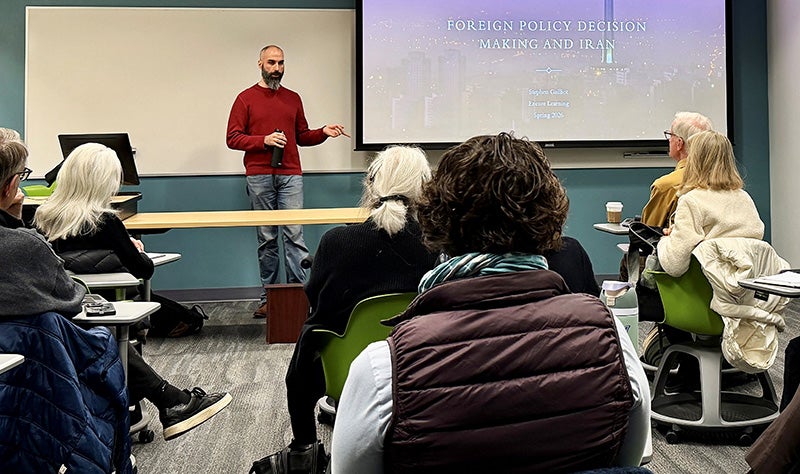
Then again, some topics beg for the “lightbulb moment” pedagogy. Take Stephen Gailliot’s Encore Learning course, the very timely U.S. Policy and Iran.
“My favorite part of teaching is when students ask questions or offer perspectives that take the class in an unexpected direction,” said Gailliot, a doctoral candidate in the PhD in Political Science program. “Although I prepare lecture notes and slides that I think will benefit the students, I learn from them in the moment what their interests are and adapt to make the material more relevant to them.
“In those moments,” he said, “I can see the impact when a concept or idea clicks for them because it is now grounded in something they know and care about.”
While he says he volunteers with Encore Learning “for the fun of it—I enjoy the topic and value informed discussion about foreign policy issues,” he also enjoys the students who sign up.
“The learning environment at Encore Learning is both welcoming and inclusive,” he said. “It is very positive space for teachers and students alike.
“Encore Learning students ask more questions and drive more discussion than the undergraduate students I teach. They come to the course with considerable knowledge, experience, and appreciation for learning, which fosters an especially engaged and intellectually curious classroom environment.”
For more information about Encore Learning,, click here. Those interested in becoming an instructor, send an inquiry to info@encorelearning.net.