
In This Story
George Mason University doctoral candidate Jolypich Pek is performing cutting‑edge research with Lawrence Livermore National Laboratory (LLNL), using statistical modeling to help solve complex physics problems and support the future of large‑scale scientific research.
Originally from Cambodia, Pek moved to the United States during high school and began her academic journey at Northern Virginia Community College before transferring to George Mason. With a strong sense of purpose and focus, she credits that pathway—and the support of family in the region—for helping her adjust to a new country and academic system so quickly; she completed her bachelor’s degree in mathematics in only three years.
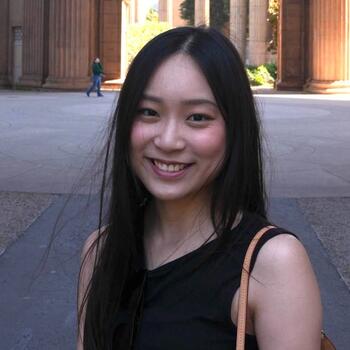
Motivated by both intellectual curiosity and career applicability, Pek chose to pursue a PhD in statistics at George Mason. “Statistics is applied,” noted Pek. She added, “With statistics you can pursue a lot of industry careers. Basically, everyone needs it.”
A pivotal opportunity emerged after enrolling in a linear modeling course with assistant professor Ben Seiyon Lee, who introduced Pek to a research opportunity with LLNL. The project, funded through LLNL's Academic Collaboration Team Program, focuses on developing faster and more efficient ways to generate equation of state (EOS) tables, essential datasets used in physics and engineering experiments. It has formed the basis of her doctoral research.
“The project is called semi‑parametric modeling of equations of state for dissociating materials,” Pek explained. “We’re using statistics to make EOS table generation faster.”
Traditionally, producing these tables relies on costly simulations and physical experiments. “Each sample point can be expensive to obtain,” Pek said. In order for this data to be usable in large-scale hydrodynamics simulations, which is critical to much of the ongoing work at LLNL and similar institutions, these sample points have to be stitched together into a mathematical function, the EOS. This is where Pek’s work of applying statistical modeling to learn from limited datasets and accurately predict missing values to efficiently construct such EOS models comes into play. Her work could potentially also be used to suggest new experiments where data is crucially lacking, thereby serving as a strategic cost-saving tool that targets the physical regimes where new data will most effectively refine the EOS model and reduce the model’s uncertainty.
The project’s interdisciplinary nature has pushed Pek to expand beyond her statistical training. “I’d never worked on applying statistical methods to a physics problem before,” she said. “I also needed to understand the actual physics problems enough to be able to apply the statistical computation that I know.”

In summer 2025, Pek brought her work to LLNL through the Defense Science and Technology Internship program. The experience immersed her in national lab culture and the interdisciplinary collaboration she needed.
“I was able to bring my project on site, work there as an intern, and meet my collaborators,” she said. “People at LLNL really have passion for what they’re doing. It’s a mixture of research and industry.”
In summer 2026, Pek will return to LLNL as part of the Data Science Summer Institute, continuing the same research that forms the foundation of her doctoral dissertation.
These opportunities have solidified an interest in working at a national laboratory after graduation. “Right now, I’m looking toward a career at a national lab,” she said. “Working on interesting, high‑impact problems—that’s really motivating for me.”
For Pek, the journey from mathematics to applied statistical research reflects both her academic growth and her commitment to solving complex real-world challenges. She demonstrates the power of George Mason’s research‑driven, practical approach to graduate education.