

The Virginia General Assembly is currently in session, and it is laser-focused on making big changes that will impact the lives of every citizen. Joining David Ramadan and co-host Commander Greg Brandon is the General Assembly’s chairman, Marcus Simon. Together, they discuss the state’s efforts to bolster public safety, from improving work relations with ICE to changing regulations about gun ownership. Marcus also explains their plans for redistricting, as well as why it is highly similar but still vastly different from gerrymandering. Find out what your elected officials are doing for everyone’s sake and what you can do as a citizen to let your voice be heard.
Listen to the podcast here
The Virginia General Assembly is in session. While most people are busy watching Washington, Richmond is making decisions that will directly affect public safety, the budget, and even the shape of Virginia’s congressional map.
Our guest is Delegate Marcus Simon, who chairs the House Public Safety Committee and also serves on the Courts of Justice, General Laws and Rules. He has also become one of the General Assembly’s most visible voices on redistricting. Especially as Virginia voters face a statewide referendum on a proposed constitutional amendment that would allow mid-decade congressional redistricting under certain conditions. As a matter of fact, we are doing this on March 7th, 2026. Voting on the redistricting started.
Joining me as well is Greg Brandon, retired Navy commander and graduate student at the Schar School. I am glad to have Greg with me, who is a student in my government 510 graduate class. We’ll keep it short and sharp, what’s actually moving this session, what this redistricting fight is about, and what students and citizens should be watching next. Delegate Simon and Greg, welcome. I had the honor and pleasure of serving with Marcus when I was in the General Assembly. We’ve kept a good friendship throughout the years. Delegate Simon, or I should say, Chairman Simon, good to have you with us.
Thanks. I’m happy to be here. I remember serving with you for a couple of cycles there. The dynamic was a little bit different when we were together. You were part of that larger majority. I was part of a truly super minority at one point, where we couldn’t even sustain the governor’s vetoes. The role of a delegate has changed. We can talk about that a little bit at some point, but being a member of the minority, you have a certain role to play. When you take over, you have to govern. That role changes. I’ve enjoyed being able to evolve with the General Assembly.
Serving As Chairman To Three Important Committees
You opened it up, so let’s start with that, too. I was a Republican at the time. I am no longer a Republican. The Republicans had in the House a supermajority of 67 out of 100, which meant we could overrule a veto with 66 votes, having 67. Democrats were 33. The Democrats have 64 in the House, and Republicans have 34. We’re going to talk a little bit about your role now. You’re a member of the majority. You’re the chairman of a very important committee. You serve on three other very important committees. You mentioned being on the governing side versus a minority. Let’s start with that.

I’ll tell you a quick funny story. I remember, in the minority, we put in a lot of gun violence prevention bills. I put in a bill about taking firearms away from people convicted of domestic abuse. The state police and the sheriff’s office came. They’re like, “We’ve got concerns about the details of your bill. You don’t have to surrender their gun, but what do we do with it after that? How do we store it? How do they get it back? How do we receive it?” They’re worried about the details.
I said, “Guys, relax. This bill is not passing. There’s no way I’m going to get this bill passed by a majority. I’m not sure why you’re here. This is a big waste of time for all of us.” A few years later, in 2017, when we took sixteen seats to get to 49. When people would come to visit me, I had to be a little more serious. I’m like, “This bill might become law. We should probably stop and think through all the implications.”
Now that we’re in a majority with a trifecta, with a governor who’s going to sign the vast majority of the bills we send her way. There’s a lot of weight to that. It is the way I explain it. Things feel a lot heavier. One of the nice things about being in the minority is that my job was to throw bombs, make trouble, look for opportunities to stick a pull on the gears, and slow things down for you all so you wouldn’t just roll over us.
You were pretty good at doing that.
I learned a lot doing that. There’s a lot of weight to the stuff we put in. We have to take it seriously and think very carefully about consequences, intended and otherwise, and implementation. What does it look like to the agencies we’re tasking with doing those things? What does it cost to do a lot of that? People get frustrated sometimes when good policy ideas go to one of the two money committees and die, but that’s not always because we don’t want to do the policies. There’s a lot to absorb. Your implementation is not always as simple as it sounds.

That may not please at least the far left of your party at some point.
Even centrists have good ideas. We have to deal with the reality of being in the governing party and having to pay for them. There’s something nice, fun, and light about being on the opposite side. You get your wins by slowing something down. Making a bill go by for the day was a win when you were a 33-member minority. There’s a lot of consequence, but there’s a different kind of joy in that, too.
Being able to pass legislation that’s meaningful will change and affect people’s lives in a positive way. There’s joy to be gotten out of all of it. It’s a little more on the frivolity side or the fun-loving side of it. It’s more with that sense of accomplishment and satisfaction that comes with doing something hard, but significant and meaningful.
People ask me all the time, “Do you miss it?” I said, “I don’t miss the process of getting elected because that was a tough process, especially for me at the time and in the area I’m in.” You know how expensive it is, Marcus. I do miss two things. I miss being able to help people and pass stuff that changes people’s lives. I miss the friendships.
Three Important Issues Being Handled By The General Assembly
I miss the people I got to know from both sides of the aisle. I kept their friendships for years. When our audience is tuning in to this show, Chairman Simon, you would be towards the end of the session. If they had ignored Richmond, what are the two or three biggest issues that change people’s lives in Virginia that the General Assembly would have dealt with in 2026?
One of the things you’re going to notice a lot if you’re somebody who rents a house. Who doesn’t necessarily own a home, but you’re looking for housing, the leverage is going to be changed a lot. We’ve got a lot of bills that affect the landlord-tenant relationship. Not in necessarily giant ways, but in ways where things tend to be landlord-friendly. Property rights are certainly important. We want to protect those, but there are a lot of consumer protections for tenants and people who are in rental housing.
You’ll find that if you miss a payment on your rent, you’ve got more time to come up with the cash to pay that off. You’re going to find that there are fewer fees for what we call junk fees. Every time you call maintenance to do a repair that the landlord’s responsible for anyway, you won’t see a charge for that on your next monthly statement. If you want to pay by credit card or other charge, you won’t necessarily have to pay a fee for that if the landlord doesn’t give you any other way to make your rent payments.
If you’re a landlord or a tenant, you need to be aware of those changes. When it comes down to July 1st, your relationship with your tenants. If you’re a landlord, or your relationship with your landlord, if you’re a tenant, is going to be changed a little bit. You need to be aware of what we did there. They got under the umbrella of trying to make living in Virginia more affordable, more reasonable, and more predictable.
I know that ultimately at the end of the day, it changes the economics, but you’re not going to be surprised with a bunch of different fees, junk fees, and things along the way. You’re going to know how much your housing is going to cost. We thought that predictability was important. The change in that landlord-tenant relationship is not getting a lot of press about it, but it’s going to be pretty impactful. It will be my number one.
My number two change hasn’t flown under the radar as much, but how your vote counts is going to be different. There were maybe one or two swing seats in Congress of the Eleven that would be in play in most midterm years. The map’s going to look a lot different. You find your congressman driving up and down the coast if you’re in the new Eighth District from Alexandria down to Yorktown. If you’re in the center of Fairfax, you can drive across Fairfax. I can drive from my house to George Mason. I’ll probably drive across four congressional districts on that little 8-mile stretch of I-66.
For the record, you’re not running for any of them, right?
You can tell me I was going to have to make news, but I am not. My wife is in the next room. If she even heard a whisper of me thinking about running, I’d be in big trouble.
The redistricting is one of the largest issues that is coming up. We’re going to talk about it in a minute. Before we move on to that on the redistricting, and you mentioned affordable housing. What is the third top topic that you would put out?

The way we approach public safety is going to be a little bit different. You’re going to see an emphasis on getting to some of the root causes of public safety problems. As opposed to trying to deal with them after the fact with harsh sentences. That’s the philosophical difference. A lot of Republicans, and frankly, even some law and order Democrats. They believe that if we have harsh sentences, mandatory minimum sentences, long time of jail, that will deter crime. Certainly, with gun violence. You’re going to be looking at taking more proactive steps.
It is to make sure that people who shouldn’t have firearms aren’t able to get them, access them, and take them out of households and situations where you have a dangerous person. Whether it’s due to their prior behavior, alcohol addiction, or other things. It is being able to remove firearms from folks. Certain types of weapons that have no business being on our streets will be illegal come July 1st, whether that’s importing new assault firearms or being able to purchase and manufacture what we call ghost guns, or these unserialized firearms.
Those won’t be available in Virginia. I wouldn’t be promoting this policy if I didn’t believe in it. It would be a safer commonwealth for those things. We’ll take a more public health approach to a lot of the problems of crime and criminal violence. A lot of the folks who are in our county jail are suffering from mental illness. If you walk into your local county jails and see the number of people that are receiving mental health services while they’re in jail. They essentially function as our largest mental health facilities in the commonwealth in many jurisdictions.
Thank you for that. For the record, though. The new gun and weapon restrictions are only going forward. All that has been adjusted. Whatever guns they own that have been purchased legally up until July 1st, will remain legal in people’s possession.
That’s why I talked about importing new ones. You’re going to be explicit. I was trying to be a little subtle about it, but that’s right. Nobody’s going from door to door, collecting people’s firearms from their cold, dead hands or otherwise. If you have a very large magazine, if you have a very powerful firearm, or if it’s got all kinds of extra features to it currently. You’re allowed to have that. You can leave it to your children. You can give it to your immediate family members, but you can’t sell it to somebody else. You won’t be able to purchase new ones and bring them into Virginia.
The ghost guns are more of a blanket ban. You’ll have an opportunity to get your unserialized firearms. If you’re a hobbyist, you bought one of these kits online because you thought it’d be fun to finish the gun yourself. You can keep that one as well. You’ll have to go to a federally licensed firearm dealer and have it serialized so that people understand where it was and where it came from and can trace its ownership backwards if it’s ever found to be used in a crime.
How The General Assembly Deals With ICE And Immigrants
Commander, I’m turning it over to you for a few questions to Chairman Simon.
Thank you, Dr. Ramadan. For the record, I retired as a Lieutenant Commander.
I’m still going to call you a commander.
Thank you very much. With respect to public safety, with an ICE being in the communities and its effect on public safety. It is real because immigrants are part of the nation. They’re residents. They need to feel safe. The presence of ICE doesn’t make them feel safe. Speaking of the jails being full of people with mental health issues. If immigrants don’t feel safe, then they won’t feel safe to identify someone who’s having a mental health crisis. I was wondering what the General Assembly has done or can do for that.
We’re going to address that in a couple of different ways. There are three big buckets. In the House, we got this down to three big bills that all came through the Public Safety Committee that I chair. I’ve had a role in helping shape these policies and figuring out the nuances of some of these bills. First, there’s going to be a bill about where. We call it the Protected Places Bill, but as a shorthand. It will talk about where ICE is allowed to conduct activity here in Virginia.
It’s going to say that we don’t want them, and they’re not able to do enforcement activities at public schools, public libraries, in courthouses, and in other sensitive places. They are listed in the college campuses, for instance, without a judicial warrant for an activity. They can’t be running around with these administrative warrants signed by themselves. It says, “I decided that I found that I have probable cause.” You go to your buddies. I go to a car salesman where everybody’s a manager, but I’m going to get my manager to sign off on this warrant.
If they do conduct activities on these protected places, they’re going to be liable for civil damages to the people that they impact and that they harm. The attorney general will also have the authority to pursue civil damages against them. We got a lot of questions about how we can even do this to ICE. There’s a federal supremacy clause. You can’t tell them what to do. That may be true on a criminal basis, but we can say, “You’re going to be liable for your actions and violating people’s civil rights if you conduct it in any of these sensitive places.” We’re going to try to pierce your sovereign immunity and allow folks to sue you personally for those things. That’s going to create a cause of action there.
The second group is we’re going to reform the way we do what these are called 287(g) or these cooperation agreements between local police and jails and the federal officials. We’re going to require that these 287(g) agreements, or any agreement that’s entered into, follow certain ground rules about what is going to happen. If you have a 287(g) agreement, ICE will have to agree not to operate with masks on and to wear clothing that clearly identifies them as a federal agency. It may not be a name, but it’s a unique identifier that’s visible to folks. They know who they’re dealing with and who they’re encountering.
They’ll also have to agree to avoid these sensitive places if they’re going to have an agreement. They’re also going to have to agree to use judicial warrants and judicial detainers before they pick anyone up. I know that sounds like a lot. There’s some nuance to all of that. We’re not banning 287(g) agreements. We’re not saying, “You shall not cooperate with ICE,” because frankly, we all want ICE to do their job and to do what was promised, which is to seek out, find, and deport dangerous criminals.
No one disagrees that we shouldn’t have dangerous criminals on the streets, be they immigrants, whether they’re here lawfully or unlawfully, and whether they are US citizens or not, frankly. We don’t want to do anything that would interfere with the federal authority’s ability to exercise their proper role in seeking out folks that have deportation orders that have been deemed dangerous or committed actual crimes and pose a danger to health and safety.
Instead of banning these agreements, which some people have called for and is a simple answer, we’ve done the hard work to say that you can have the agreements, but within those agreements, we want you to make sure you meet certain minimum standards that the public expects from you. The third thing is about this whole masking generally. We’re going to require all law enforcement in Virginia to adhere to a model policy about masks. That’s another one. This goes to the very top with Professor Ramadan.
It’s easy to propose a policy, but then you start thinking about how to implement it. The first initial thought was, “Let’s ban masks.” The police come to us and say, “What about motorcycle cops? They wear face shields.” You want them to be able to do that. What about if you’re dealing with somebody who’s sick and coughing all over you? Should you be able to wear an N95 mask? You should be able to do that. What if it’s your motorcycle cop and it’s eighteen degrees outside? Should you be able to wear a knit mask over your face? You can.
Rather than banning them, let’s adopt a model policy and make sure that we get it right. Make sure we’re not impeding useful masking policies. Let’s not wear masks for the sole purpose or the primary purpose of not letting people be able to tell who you are or that you’re in fact law enforcement. Those are the three big categories of things that we’re passing legislation on. The goal, frankly, is to keep law enforcement focused on their core jobs.
There was an incident. A woman was stabbed to death, unfortunately, here in Fairfax County by someone who was an immigrant under a removal order who’d been in and out of Fairfax County’s jail eight times, four times in the last twelve-month period. In none of those cases did ICE issue a detainer and come and get this person from Fairfax County before his release. It’s not that we didn’t tell them that we had him.
I’ve talked to Sheriff Kincaid about this. Everybody knew where he was, but ICE, unfortunately, was distracted on missions in Minnesota and surging on doing some of these high-profile dress-up things that they’re doing. They are not focusing on their core activities. We want police to be able to work on their core public safety functions, keep our community safe, and not be distracted by trying to hit artificial quotas or do newsworthy things that get splashed across Fox News and make headlines. Let’s do the boring work of keeping folks safe. That’s what we want to keep folks focused on.
Thanks.
That was a bit of a filibuster of an answer. You probably have more questions, but you wind me up, and I start to go.
That’s what I wanted to hear. That is a thorough answer to this important question. Thank you.
Understanding The Impact Of Redistricting In Virginia
Preparing for this episode, Marcus, I thought of probably about twenty questions to ask, but then knowing you well, serving with you, and knowing that you will filibuster some of these. I cut them down to four or five of my mind that I’ve got to go over. That’s fine. Let’s talk a little bit about the redistricting. In plain English, what exactly are you all proposing to do for our audience to understand?
We want to make sure that we level the playing field on a nationwide basis here. We’re talking about a national election. It’s all these elections for better or for worse. Tip O’Neill once said, “All politics is local.” That paradigm started to shift. A lot of what’s happening here is national. A lot of these elections are won and lost on national issues. President Trump knows this as well. That’s why he’s gone from state to state, insisting that governors and state legislatures deliver him, “Give me five seats. Go get me the seats.”
It is with varying degrees of success. To their credit, the Indiana State Senate said no. We’ll see what the electoral consequences are for them. If everybody said no, I’d be happy to say no. We don’t need to change it the way we do maps. If everybody were saying no to the president, we’d all be in a much better place. I’d be thrilled not to have to be advocating for the redistricting process that’s happening in Virginia. The fact is that in Florida, Ohio, North Carolina, and Texas, to varying extents, Republican legislatures and Republican governors are answering the president’s call.
They’re promising to deliver him, or at least they’re going to try, the seats that he’s asked for. What we’re doing here in Virginia is saying, “Here’s a blue state with a blue trifecta. How can we balance that out and level the playing field so that we get a Congress that reflects the will of the American people?” It’s a temporary measure. We passed a redistricting commission and we put it into our constitution back in 2020. We need a constitutional amendment that says, “For the rest of this decade, until 2030, should another state do a mid-district redistricting act that results in changing the number of seats they have for a reason other than a court order, then Virginia is able to do the same thing.”
That trigger has probably been met at this point. We’ve done a couple of things to be transparent about what we’re doing. We passed legislation in October, right before the election, and then again, right after the election, to create a constitutional amendment that would say for the rest of the decade, Virginia’s general assembly is free to draw congressional maps. We also went ahead and, in the enabling legislation, have already shown folks what that map would look like. It’s a map that carves Virginia up in a way that favors Democrats in 10 out of the 11 congressional districts.
If the mood of the Commonwealth is similar to what we saw during our state elections in 2025, and these are based on past democratic performance, this is a map that should result in 10 out of the 11 congressional districts being filled by democratic candidates. That goes away at the end of 2030. After the new census, the redistricting will revert to being done by the redistricting commission. At that point, we hope President Trump will have served out his term, will no longer be president, and won’t be able to ask other states to fix their districts for him.
That’s an excellent explanation of what’s happening with the redistricting. Greg, you have a question or two on this?
It will be 2026, if passed, 2028, and 2030.
The census happens in 2030. By the time it’s done, it won’t be done in time to change the district. That’s always the case that there’ll be an election following that zero year, that we get the new districts.
I’m a big fan of efficiency. It’s inefficient the way our congressional districts are now, particularly in Northern Virginia, with 60% to 70% democratic. We can spread the wealth. Also, when I looked at California with its 54 congressional districts, I looked at the before and after map in the Southern California area. It was easier for them to spread the wealth and get things out into Riverside County and down into Orange County, which had already been turning a little blue. It’s just an observation.

It’s resulted in some ugly-looking districts up here. No doubt. The new seventh is what they call the lobster district. The fact is, here in Virginia, we as Democrats and Republicans, even though the state in the lowest point and where Glenn Youngkin was able to win by about 50,000 votes. We can see we’re arguably a 50/50 state at that point, although the last couple of elections we’ve shifted more democratic. It’s where those votes are concentrated in this urban crescent.
A good chunk of the population of Virginia is inside the Beltway. To go get those democratic votes to spread out, you have to send these fingers as you would into Northern Virginia. You have these narrow bands of Northern Virginia that get them spread out as you leave the metropolitan areas. It’s just because our urban-rural divide is pronounced here in Virginia. It does have some odd-looking results, but the idea is that when we did redistricting, you looked at counties and things.
You wanted to keep them together. At the end of the day, even though we have an anti-gerrymandering amendment. The special masters who drew our state house seats were conscious of political realities. One of their charges was not to create an overall map that favored or disfavored one political party over the other. I’d argue that what we’re doing with redistricting Virginia is to do the same thing on a national scale. We want to have a map that doesn’t unfairly favor the Republicans over Democrats because we’re doing redistricting one way in Virginia, and people are doing redistricting a whole other way in the red states.
Was there any war gaming as far as the local effects here in Virginia?
As a former military person, I was an Army JAG myself. We always red team, blue team these things, as we would say. You want to think through all the different possible scenarios and then adjust. You look at what’s happened to other places and look for their after-action reports. Yes, there are some thoughts about some potential problems. In fact, you saw a little bit of tweaking. After the map came out, we looked at the second and the third congressional district and said, “Why do we keep the third so safe and make that such a tough potential outcome in the second district?” We were able to move a few more votes over there.
Also, it’s thinking through how to sell this on the referendum because we’ll be about halfway through early voting on this redistricting. The outcome’s certainly not a foregone conclusion as far as I’m concerned. It’s going to be close. What are the pros and cons of showing the map ahead of time? The pro is, “It’s transparency. This is what we’re going to do. We want to be honest about all of it.” The downside is, “I like the idea of a 10/1 map. I like the idea of balancing things out and canceling out what Trump’s doing, but I don’t want to lose my congressman.”
Now that you’ve seen the map, you’ll have some people who’ll be torn. People like to see what it actually looks like. We do give some feel to the other side when they can pull out one of these weird-looking districts and say, “Does this shape look like democracy? Does this seem fair to you?” That’s the downside of that. We had to balance those competing considerations as far as coming up with a strategy for how to do this. Ultimately, we wanted to be able to argue transparently about what we were doing.
Thanks.
Marcus, critics are going to say, “That sounds like a political and polite way of saying, ‘I’m gerrymandering.’” Are you?
We are going to level the playing field. Sometimes, you’ve got to bring the same tools. It’s the old saying. “You can’t bring a knife to a gunfight.” Gerrymandering means what? It is being conscious of the political outcome, I suppose, in this day and age. There are all kinds of gerrymandering. There’s been racial gerrymandering that was used for years to diminish the voting power of certain minority communities.
It is illegal now. Political gerrymandering is legal.
The Supreme Court has said, “If it’s purely political, it’s allowed.” They’ve repeatedly upheld it. Whether you like that or not, and whether you think that ought to be the law or not, we’re dealing in reality here. We’re dealing with, frankly, the future health of our democracy. If one side lays down their arms, turns the other cheek, or whatever analogy you want to use.
You’re going to get run over. We all sit back and post about how righteous we were, but when you lose voting power, you lose representation. You lose the ability to have future elections, which is what’s at stake here. I don’t want to be too dramatic about it. Being on your moral high horse doesn’t help you a whole lot.
This is not to put you on the spot. I know you can handle it. I heard this as, “Yes, we are gerrymandering, but 1) It’s legal. 2) It is fair since we didn’t start it, so that we can save democracy.” Did I misquote you at all?
Gerrymandering is a bad word, but it doesn’t have to be. Dick Saslaw always used to say there’s good gerrymandering and bad gerrymandering. The punchline was, “It’s good when we do it. It’s bad when they do it.” Taking politics into consideration is a good end here, particularly when it’s about making sure that the outcome of our national elections reflects the will of the people. That’s what democracy is all about.
The constitutional amendment is on the ballot. There’s a special election. Early voting has started. Election day is April 21st. If this passes, it needs a simple majority.
The majority of the votes cast.
If the simple majority of Virginians vote yes, then there’ll be new maps and new districts in November for Virginians to choose their representation in Congress. Instead of the 6 Democrats and 5 Republicans that are there, you’re anticipating, based on the new districts, 10 Democrats and 1 Republican that’ll go to Congress for three terms. Did I get this correctly?
That’s it. Some of these are not slam-dunk districts every year for the next cycle. If you’re not running against Donald Trump come 2030, some of these may be a little bit more difficult to maintain, but we’ll have to see.
Why Should You Care About The General Assembly’s Sessions
We’re running out of time. We took quite a bit of yours. I can spend another 30 minutes with the commander and you talking about different issues, but let’s bring it home for Mason a little bit. You represent part of the Fairfax area. For Mason students who, like most people in Northern Virginia, are turned into DC and barely follow Richmond, make the case. Why should they care about what happened and happens every session in Richmond?
I grew up the same way. I grew up here in Falls Church, in McLean, at McLean High School. My dad worked on K Street downtown. I was very focused on the federal stuff. I got a job years ago. I was working for a guy named Jim Scott as a legislative aide and making $13,000 a year. I went with him to Richmond, which is a city I’ve maybe visited once or twice, even though I’d grown up here in Virginia. I watched from January, when we started introducing bills at the request of constituents to help fix very real problems they were having.
You watched it go to subcommittee, get reported out of committee, and get to the floor all within about the first 30 days. In the second 30 days, you repeated that process in the Senate. By April of that same year, the governor had signed it into law. By July 1st, it was in fact the law. You could sit there. You can watch that whole process in a very digestible timeframe. The most amazing thing to me was that everybody was in their seats on the floor. If you have ever watched C-SPAN, you’ll see people giving speeches on the floor of Congress.
They’re speaking to an empty room and a camera, but we listened to each other. We were all there at the same time. You cast your vote. You heard the arguments. You cast your vote in real time. It’s all an accessible process. My recommendation is to focus on that because it’s where you can make a difference. A lot of times, what’s happening in the world feels overwhelming to my kids. They’re like, “What’s the point of doing any of this? What can I do?” When you go to Richmond, it’s at a different scale because it’s happening quicker and smaller. You can be there to make an important difference.
We’ve had folks who have come down and served as interns. That turns into a part-time job, which turns into a full-time job. We’ve had deputy secretaries of cabinet-level positions in their late 20s and early 30s. They are making big decisions that impact the state government in big ways. Come be a big fish in a smaller pond in Richmond. Pay attention. The things we do matter.
The other way I explain it is, from the moment you back your car out of your driveway, will you be able to back out of the driveway, or is the traffic going to be so gridlocked that you can’t get out? To drop your kids off at school at a carpool line, what size is the classroom that they’re going to be going into? How many kids will be there? When you have to get them to work, will you have to pay tolls to get there or not? How much are they going to be? Is your employer going to have to offer you paid sick days or not?
All those questions that will affect you every moment of every day are made at the state level for the most part. They’re happening there. You get yourself burrowed in there and make yourself known. You can impact all those decisions for a lot of people before very long. You don’t have to wait until you’re at my age to make a difference.
Here at the Schar School, Marcus, we are working hard on creating experiential civics education. We have a pilot course that we developed that has a small budget item in the 2026 budget in Virginia. Chairman Krizek carried it on the House side. Senator Marsden carried it on the Senate side. The money has been placed on both sides.
We need to come up with a good number between them. You all on the House side were generous and put in $250,000 for us to do that. The idea behind it is to get a couple of hundred students to get experiential civic education through the General Assembly and local governments. Your support for that in the final run would be greatly appreciated.
We need those young, fresh, energetic, and talented folks because they bring great ideas. We’ve been around for a while. We can’t think of things. The world’s changing. That youthful voice, knowledge, and experience are important.
Thank you. We’re hoping that after the pilot is funded by the state, we’re going to go to the feds and try to get permanent money for it to be not just a pilot, but a permanent center of experiential civics at George Mason. Before I ask the last question and close it out, Commander, do you have any final thoughts or questions for the Chairman?
The General Assembly had a role in protecting Dr. Gregory Washington when the Board of Visitors tried to oust him. I want to recognize that and show my appreciation for that.
He’s a great guy. We rallied to his side and on his behalf. We know what a fine person he is. That’s where it all goes together. At the state level, you get to know your university presidents. You get to know what kind of people they are. The folks nationally don’t understand the people that they’re sometimes targeting. They see them as very one-dimensional. They say, “He’s a woke guy. He’s doing DEI stuff.” That’s not what it’s about. It’s not as simple as that. There’s a lot more to it. We were able to help educate folks and come and make sure that he was treated the way he deserved to be, which was very well.
Reach Out To Your Elected Representatives
Thank you for defending Mason, protecting Mason, and protecting our president. Final thoughts, Chairman Simon, the floor is yours. Please include how your constituents and those of others in the area can and should get engaged with you.
It’s a beautiful thing being part of a representative democracy, the oldest continuously meeting legislative body in the Western hemisphere, the House of Delegates, which is the upper house. Don’t let the senators tell you otherwise. I’d say that even if they were here. Stay engaged. First, know what district you’re in. Know who your representative is. It’s amazing how easy and accessible we can be, unlike some of the national figures that you see. Call my office.

I’m liable to call you back myself. Send an email. Let us know how you feel. Show up at town halls. You can show up with one of 30 or 40 people and have some real face time with your elected officials if you show up. Step one is to educate yourself about who represents you at the state level and at the local level, who your representatives are, and to be a squeaky wheel. It’s not hard to stand out from the crowd.
Not a lot of people take the time and make the effort to make themselves known and make their wishes known. You can have an outsized influence that way. We need to hear from you, too. We need to be able to explain to folks from other parts of the state, “I can’t be with you on this,” or “We can’t do this. My constituents won’t let me get away with it.”
I’d like to be able to lean back and say, “My district doesn’t support that. Here’s how I know. I’ve gotten 600 emails about this. I had 30 people come through my office. I had 100 people show up at my town hall to tell me, ‘Don’t you dare.’” That’s powerful for us. We need to make the case for protecting our community’s values, our district’s values, at the state level. You can always find me on my website, MarcusSimon.com. It is very easy. It has all my contact information. All my social media connections are there. All the best emails and phone numbers are right there.
To find out who your legislator is, go to Google and type, “Who is my legislator?” It’ll take you to a website that the Legislative Services and General Assembly have created. You put in your address. Tell you who your state delegate is, who your state senator is, who your congressman is, and who your US senators are. I hope that you at least know those and know who they are. As Delegate Simon said, they’re accessible and available to reach out to and be engaged.
Chairman Simon, thank you for joining us in the middle of the session and helping us cut through the noise. Commander, thanks for co-hosting and helping bring the students and public service perspective into this discussion. You can find this and all episodes of Policy and Governance Perspectives at Schar.GMU.edu/Podcast, or wherever you get your podcasts. I’m Dr. David Ramadan. Until next time, stay informed, stay engaged, and keep one eye on Richmond. Thank you.
Thank you.
Important Links
About Chairman Marcus Simon
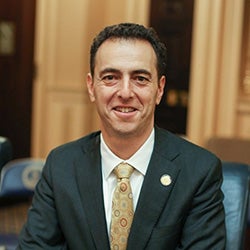
Delegate Marcus Simon is a lifelong resident of Fairfax County, Virginia where he currently resides with his wife Rachel, and two children, Emily and Zachary.
Early Involvement in State & County Government
After returning from four years of College in 1992 with a Bachelor's degree in Middle East Studies and Journalism from NYU, Marcus went to work for Delegate James M. Scott as his first full time legislative aide. He rented a house in Pimmit Precinct which also served as the unofficial 53rd District local office. Marcus worked on Jim's 1993 re-election campaign and accompanied him to Richmond for the 1993 and 1994 legislative sessions. In 1995 Marcus went to work for then Providence District Supervisor, and candidate for Chairman of the Fairfax County Board of Supervisors, Katherine K. Hanley. He moved with Kate to the Government Center after her successful special election campaign, and remained on her staff for the next five years. In the fall of that year he began attending Law School at American University's Washington College of Law at night.
Military Service
Marcus left the Chairman's office after graduating law school in 1999 and receiving his Commission as an officer in the U.S. Army Judge Advocate General's Corps. Although he'd volunteered to spend his first year as JAG serving in Korea, his assignment was changed during the final days of his training in Charlottesville, and he was assigned to the Military District of Washington and Ft. Myer, in Arlington. As an Army Captain, Marcus served as a prosecutor where he handled officer misconduct cases and all criminal cases on Ft. Myer, Ft. McNair, and the Walter Reed Army Medical Center. He also served as a part time Special Assistance United States Attorney prosecuting civilians who committed crimes on federal military installations in the Washington area. Marcus also provided legal support to the Emergency Operations Command Center on Ft. McNair during the days following the September 11, 2001 attack on the Pentagon.
Private Practice
Upon completion of his military commitment, Marcus entered private practice in 2003 working as a Real Estate attorney in downtown McLean. In 2008 Marcus co-founded the Law Firm of Leggett, Simon, Freemyers & Lyon and Ekko Title, a real estate settlement, title and escrow company. Ekko Title now employees over 40 people at its eight locations throughout Northern Virginia from Fredericksburg in the South to Reston and McLean in the North.
About Greg Brandon

Greg Brandon is a retired Surface Warfare Officer in the U.S. Navy. He has an MBA from Marymount University and an MA in Political Management from George Washington University. Greg is currently an auditing student at George Mason University's Schar School of Policy and Government. He has been involved in Democratic politics in Fairfax County for the past fifteen years.