
Municipal government may be the closest level of authority in every home, but it seems many people do not really understand how it runs. David Ramadan unpacks what it is like to run a municipality with the Hon. Catherine Read, the first woman mayor of Fairfax City and the first George Mason graduate to hold that office. Together, they discuss the responsibilities and powers of a municipal mayor, as well as the city manager and the municipal council. Mayor Read also presents the biggest issues in Fairfax City on top of her priority list, from improving the transformation system to navigating high-density housing.
Listen to the podcast here
In this episode, we're talking about the level of government most people think of last but that affects their lives first and I would say the most, municipal government. Our guest is Mayor Catherine Read, the Mayor of the city of Fairfax, George Mason's hometown. She's the first woman and the first Mason graduate to hold that office, earning her BA in Government and Politics here in the early 1980s. She's a long-time Fairfax City resident, a strategist and advocate who's worked with local nonprofits on legislative advocacy and messaging, and she's deeply engaged in building stronger ties between Fairfax City and our alma mater, George Mason University.
Mayor Read was first elected in 2022 and reelected in 2024 leading a city of roughly 24,000 residents right next to our campus. We'll dig into what a mayor actually does, how a city really works, why local government matters more than the shouting on cable news, and how students can engage beyond just complaining on social media. Mayor, welcome to the show.
Thank you so much. What a great introduction. You have teased this up magnificently.
How Mayor Read Got Into Public Office
Thank you. First segment. Let's talk a little bit about why local government in general. Let's start with your story and the Mason connection. For our readers who may only know you as the mayor of the city next to campus, give us the short version of your path. Who is Catherine Read and how did you end up in the mayor's office?
Let's go all the way back to fifth grade. Let's start there because I’ve always been interested in politics. In fifth grade, there was a presidential race. Richard Nixon was running.
Hold on. You're really taking our students back to Richard Nixon. I hope that they do know Richard Nixon.
How we're shaped by where we grow up. I grew up in Southwest Virginia. At the time, I was living in Christiansburg, Virginia, which your readers may know as being right next to Virginia Tech.
That other university.
Everybody in Southwest Virginia was a Republican in 1972. If there were Democrats, I didn't know any. I was like, “Richard Nixon needs to be elected in 1972.” In fifth grade, I wanted to do a bulletin board in my classroom with newspaper clippings and stuff about this election. My teacher, Mr. Rodney Downs, was like, “You have to do something on both candidates, so you can do a bulletin board, but you have to represent both candidates.” I did that. I'm in fifth grade, how old are fifth graders, 10, 11?
I followed politics not necessarily at the local level, but at the national level, even though I decided ultimately by the time I graduated from high school, I wanted to be a Theater major. I went to Emerson College in Boston my freshman year to be a Theater major. The fact of the matter is what brought me to George Mason University was the debate team and the fact that I was on the forensics team at Emerson. Back in 1981, George Mason University was kicking everybody's butt in every tournament because they had the number one debate team in that collegiate ranking. They were number one in the nation.
I'd never heard of George Mason University. People in Boston at Emerson were like, “You must have heard of George Mason because you're from Virginia.” I'm I’ve lived my whole life in Virginia. I have never heard of this school. When I looked into it, I realized two things. It's a state school, which means I would pay in-state tuition. It was close to Washington, DC, and not out in the hinterlands where I grew up and had no interest in returning. They were building a dorm. There was no on-campus housing in 1980.
When I looked into this, I'm like, “I can go back to Virginia, I can enroll at George Mason University, and I can live on campus because they're going to open this dorm in August of 1981.” It was this circuitous route from Christiansburg then to Roanoke, which is where I went to high school, and then to Boston, and from Boston to Fairfax. I landed in Fairfax on the campus of George Mason University at the age of 19 in 1981. In 2022, at the age of 60, I ran for mayor. What we're going to talk about is all the stuff in between.
Back then, there were 2 or 3 buildings. The East and the West buildings and that one dorm.
There was the four original buildings, there was Fenwick Library, and Robinson was the new building. There was a student union and they built a new student union while I was there. I think when I left in 1984, there were 500 students living on campus. This is the other thing. It’s how crazy how life works. My moving into that dorm on October 25th, 1981 changed that school from a commuter school to a university, like all the other universities. Just the act of building a dormitory and having students move into it changed how people perceived George Mason University from being a commuter school.
I can look back on that now because it's been over 40 years, but at the time, when you're in the middle of these things, you don't think about these inflection points that somehow are changing the course of this university because back then, it wasn't William and Mary or UVA or Virginia Tech, which by the way is where all my classmates went. I was going to this school that my grandmother, to her dying day, could never remember the name of. She's like, “James Madison?” I'm like, “No, it's George Mason, Granny.” She was like, “What are you talking about?” Here we are, the largest university by enrollment in the Commonwealth of Virginia and this has all happened in my lifetime.
Bless her heart, as my mother-in-law from Southwest Virginia would say. You're a proud Mason alum, therefore. How did this experience as a Government and Politics major back in the day shape the way you think about public service now?
I was very fortunate because you know it was not just that we had a great faculty and a great staff back in the 1980s and many of them had experience in government themselves. The proximity of the university to Washington, DC cannot be overstated. Aside from an accomplished faculty, I was taking classes with a lot of adult students. I had a lot of night classes. The closer I got to my senior year, junior and senior year, I was taking a lot of night classes because there were adult students coming to the university to get their undergraduate degree.
I was sitting next to people who were working in federal government and were coming back to school to get the college degree they didn't get. Being with adult learners who were also in government actually doing the work while they were getting a degree also made a huge difference. I wasn't with people my own age throughout my entire time at George Mason University. People sitting next to you, people in the room with you, the discussions you have when you have a different mix of people makes a huge difference in your understanding of how it all really works.
Why Mayor Read Chose To Run For A Municipal Position
I second all of that because I had a similar path and I did my undergraduate in government and politics at George Mason and my Master's degree at George Mason and that was a huge draw for me as well, having both fellow students and professors that are really practitioners that are coming out of DC every day doing the work and then coming and sharing their experiences with us. All right, we keep saying next to DC, people coming out of DC, people with DC experience. You could have focused on federal or state office like many politically minded people would. Why municipal government?
It's been a long and winding road. I will tell you I remember one class that I took and it was a class on bureaucracy and in it was a senior level class. Think about bureaucracy in the 1980s. Can I just remind you, these are the Ronald Reagan years.
The shining city on a hill now. Remember, I am a big Reagan fan here.
These were the Ronald Reagan years, so it was class on bureaucracy and the gentleman who taught the class, I wish I could remember his name, his father had worked in FDR's administration. He was a fascinating person and he was just a living history book. Bureaucracy is a very tedious, boring thing to be talking about for you know an hour twice a week or three times a week. A large part of your grade was class participation.
If I remember correctly, that was the only class I took where right from the beginning on the syllabus the professor says, “A large part of your grade is going to be class participation.” There were generally only two people who ever participated, me and this other young man who I remember clearly had an internship at the time at the White House. It was so impressive to me because I was a work study student on a Pell Grant and I was working in the copy center on campus, hot gluing and binding and making Xerox copies of stuff.
Arguably more important stuff.
I was so awed by the fact that I'm sitting next to this and he and the professor knew that and kept calling on him specifically because he had this internship at the White House to basically talk about what had his experience been and what he had observed. This comes back to what we were just talking about. Who you're sitting next to and who is in the room makes a difference in the experience you get in education.
Anyway, they posted the grades at the end of this class because people had said this professor rarely gave a's. You couldn't get an A out of him. The only two people who got an A in that class were me and the kid with the internship at the White House. It's because we did the heavy lifting every class period to actually engage. I was not interested really in talking about the tedium of bureaucracy, I was interested in hearing him talk about the arc of government from FDR to Reagan.
I would steer the conversation in that direction because he was a fascinating, interesting man and to me that was far more interesting to hear him talk about that than bureaucracy. That class was a real standout for me. I remember it to this day and the conversations that we had and his observations about how government actually works at the federal level.
That's the point, or not work at federal level.
True, but back in the day, we had faith. We had faith back in the day that what we were being taught how the Constitution works, the three co-equal branches of government, we had every reason to believe that this is how it works. Students nowadays don't have to look very far to realize that our founding fathers assumed that people would show up in good faith to be our government because democracy is government by the people and for the people and the people run it.
They made assumptions about who would be in those roles and they put checks and balances in in case there were people who showed up who were not showing up in good faith. I think the situation we're in now, we can all agree is that across many multiple branches of this government, the people showing up are not the people that the founding fathers wrote the Constitution for. We are seeing that it is not working as designed.
You take this down to the local level. When you are in school, and I don't just mean government and politics at Mason, I talk to eighth graders taking civics classes in our local middle school. The local Rotary Club hands out Constitutions once a year, paper Constitutions, we're in the auditorium at Katherine Johnson Middle School to talk to eighth graders about the Constitution. Even at that level, students are not necessarily in civics being taught about local government.
Most of them have not been to city hall. Most of them do not understand city council or the council manager form of government or city charters or how policy gets made and ordinance gets passed. From the very earliest, we are focusing students' attention on what you need to care about is the Constitution and the federal level government and the co-equal branches and all the things that what history tells us we should be talking about.
The fact of the matter is local government is very messy, it is very homemade. People run for office who don't have experience in government, they have experience in whatever they have experience in, they're a dentist, they're a teacher they're all kinds of backgrounds in government. It's on the job training for people who step up to run for local government.
A thing we need to wrap our arms around is that that you don't have career politicians in government, everybody it's considered a part-time job. You're doing it in addition to the job that you're doing. From the from the earliest classes on government, we teach children we are not teaching them to look at the government closest to their front door to understand that.
How City Managers And Municipal Staff Keep The Wheels Rolling
I'm going to take that as you wish every policy student understood that importance of local government. I do as well. When you ran first in 2022, what'd you hear most from the voters at the doors? What did they actually care about and did they understand or at least ask you the right questions on okay you're running for mayor, we know they don't understand local government much, so what were those discussions like?
When you have a well-run city, and we do have a well-run city, at this juncture, we probably have 26,000 people living in 6.2 square miles, things run well because in a manager council form of government, we have a city manager who is basically the CEO of the city.
I'm going to interrupt for a second, sorry. On the number of people, that does not include our students on campus.
That's true, it does not. The 26,000's just the number of people and some of this is because we have recently built high-density housing projects Scout on the Circle and the Point at Fairfax and suddenly we have this influx between the 2020 census and the 2030 census. Our population has gone up because we are opening these high-density housing complexes that had not existed in the city prior to the opening of Scout on the Circle really.
If we add the students on campus, we practically double it.
There are 6,700 students. Keep in mind, too, that a lot of faculty staff and students live in the city. The Flats at University is a lot of student students living right in the downtown. They are residents. They are absolutely card-carrying residents. The students live on campus because it's a state school and it's a state university. People don't understand, people assume often that George Mason University is in Fairfax City, it's not. It's not in Fairfax County, it's its own little fiefdom managed by the board of visitors because it's a state school. They are the de facto town council for George Mason University's campus.
We are recording this on January 31st, 2025. As of this day, we do have a full board of visitors due to our new governor. We had been without a full board of visitors for few months at George Mason. All right, I digress. Sorry, the city manager.
The city manager runs the city like the CEO. We have we have veteran staff. When we do employee events we did one in December at Christmas, I'm recognizing people and the city manager's recognizing people who've been with our city for 35 years, 30 years, 25 years. These are how long people have been and we don't have a huge staff. We probably have 500 regular full-time employees who run the city and then we probably have 150 more who are seasonal or temporary employees that are hired in the summertime for parks and rec and are hired in the wintertime to clear snow.
Generally speaking, we have about 500 employees. A lot of them have been here for a very long time. The wheels on the bus turn regardless of who is elected to sit on the dais. I think a lot of people don't understand that dichotomy of elected people providing governance and fiscal responsibility to a locality and the career people who are in finance and who are in the city manager's office and who are in parks and rec and public works. They keep the wheels on the bus turning regardless who comes and goes on the dais.
When I was on the doors, what I found is that people were very happy with the city. The curbside trash pickup, number one thing they love. Most of most everything was, “Love living here, have lived here for 50 years or I just moved here because it's great to be in a city that has this close-knit hometown feel to it. It's right next to the university. It's very close to DC.” I didn't find a lot of people who were well my number one complaint is fill in the blank. We're not Flint, Michigan. We don't have the drama of lead in our water and other things that people coalesce around.
I'm so fortunate, I am so grateful that our city is so well run and so well managed. When I was on the doors people basically were talking about high-density housing because we have a lot of post-World War II neighborhoods here that right after the war ended and the GI Bill and you got GI financing for your house and so people these single-family neighborhoods, I live in one too. My house was built in 1953.
The fact of the matter is we have a housing shortage and there are people who want to live in our city who can't afford to live in our city and there's just basically not enough houses. High-density housing meets the needs of people who want to rent instead of own and they need something they can afford in a place that has access to transit and good jobs.
What I heard a lot of pushback especially knocking on doors in single-family neighborhoods is we are building too much housing. It's too dense and it's too tall and we should slow down because the people who live here and especially people who've lived here for a long time want to put it in amber. Just pull up the drawbridge, I'm here, it's good. Don't change anything. I moved here for a reason I love it, don't change it.
However, that's not reality based. You can't not change. If you stop, you get run over. You stagnate. People who are private citizens living their life and loving their city really don't understand that and so it's incumbent on the people who are elected on the dais to represent not just the people who live here and they show up and they tell us all kinds of things about what they and don't like. I keep talking from the dais about the responsibility to the future city. The people who aren't represented in these discussions about trails or intersections are the people who don't live here yet. Somebody has to care about them.
There is a relatively new term for all these great folks that don't want to change, though, the nimbys of the world. Not in my backyard.
That's true but everybody can point to somebody else who's that, but it's not them. It's not me, but my neighbor.
Responsibilities Of A Municipal Council
My neighbor is, but I still don't want anything new in my backyard. You talked about the city manager and the professional staff, tell us a little bit about your council. You are a Democrat or Republican when you run? I know the answer but I'm being facetious here. Are you a Democrat or Republican when you run for office in Fairfax City and your fellow city council?
In municipal government in Virginia, everyone is independent and that is true of constitutional officers too. The ballot is always ever going to say I, independent. That is just that statewide. Do people run as Republicans and Democrats? Yes, and they have for many years but not every locality does that. I can point to Lynchburg or I can point to Roanoke City and because people are like, “I'm the Democrat running for mayor,” or, “I'm the Republican running for city council.” You can put that on your literature and take a stand, “I'm in this party or I'm in that party or I'm not in any party. I'm truly independent. I am truly independent.” There are a lot of people who put a flag in that and say, “I am truly independent.”
A shoutout to the mayor of Roanoke. He is a good friend.
I adore Joe Cobb. In fact, I know a lot of people on the city council in Roanoke. I will say Cardinal News does a good job reporting if you look at their reporting. Lynchburg's another one where he talks about a majority Republican dais. Even though I is on the ballot, when people self-identify, “I'm a Republican,” then that's how people start to report on there's a majority of this party, there's a majority of that party.
Roanoke, in their last election, had a Republican who is now on city council and that was newsworthy, but again, everybody has I next to their name. Here in Fairfax City, I am a long-time Democrat. I have been a Democrat going back to Barack Obama, which is the first time I really got out and knocked doors. For me to say, “I'm not a Democrat. I'm independent,” would be disingenuous. It really would be because everyone knows me as a Democrat.
On my literature, I did not put that I was a Democrat because it was not germane to anything. In my city where I’ve lived for 25 years, certainly people know that I am a Democrat. We had Billy Bates, another Mason alumni, degree undergrad and graduate degree in Physics, ran as a Democrat. He knocked on doors and he goes, “I'm a Democrat running for city council.”
There are a lot of people in this city who believe that we've always had independent elections, municipal elections because when they were in May, 20% of the people turned out. May elections and this goes back to the Byrd Machine, Harry Byrd, and we have a lot of wonky things in Virginia, a one-term governor. We have off-year elections, we had May municipal elections and there's a historical basis for all of this. In fact, Michael Pope wrote a wonderful book called The Byrd Machine in which it illuminates much of this.
People in the city were like, “We've always had independent elections.” Everybody knew what everybody was but they didn't when they ran for mayor and council. No one ran that up a flagpole and said, “I'm running as a Republican.” Everybody was like, “No, I'm an independent and I'm running as an independent candidate.”
What happened in 2022 is the General Assembly eliminated May elections and basically said everybody's charter is going to change because now we are only going to do elections in November. There were a couple of reasons for that. One is the expense of running May elections for every locality in addition to also running November elections.
The other thing is that there was a suppressed voter turnout, there just were not people voting in May. That's not when people vote, people are like, “I vote in November.” I love people who say, “I vote in every election.” What they mean is, “I vote every four years for president.” That's what they mean. In Virginia, we have elections multiple times a year if you count primaries, and this past year, it's been like every month we've had an election.
People used to tell me that all the time. “I voted for you.” You and I know we don't know who people voted for but we know if they voted or they didn't vote because it's a record if they did or did not vote. I'd look it up but that person didn't vote.
No local elections. People don't realize it's public information if you voted, not who you voted for, but you can look up somebody's voting record and see whether or not they really vote every election or if they just vote once every four years for president. When the elections changed to November, then we ended up being on the same ballot with candidates who are running as Republicans or Democrats.
In 2022, there was a top of the ticket. I was running with Gerry Connolly who is a Democrat, he's a Democrat congressman. Gerry put out a mailer to my city saying he's endorsing me and the other candidates that I was running with that he was endorsing. People were like, “This is an affront. We're bringing political we're bringing partisanship into this,” but partisanship was always there. It's just that no one talked about who was what party.
Now having November elections, you are on the ballot where partisan candidates are at the top of that ballot. To strip it away and say everybody has a sample ballot standing out in front of the polling places, you ask, “Do you want a Democratic sample ballot? Do you want a Republican sample ballot?” In the last two elections, we had an independent ballot. “Do you want the sample independent ballot?” These are the candidates the independents are supporting.
To me, that is incredibly disingenuous. If you're running on a ticket regardless of what you say you are, you're running as a group. Certainly, there's a reason you coalesce together for some reason. This is where we are with politics. People don't pay attention. When they go to the polls and you say, “Do you want a sample ballot?” We had 11 people running for 6 city council spots.
You have 6 city council spots and you, that's 7, and what is the makeup now?
I'm a Democrat and Billy Bates ran as a Democrat, Stacy Hardy Chandler is a Democrat. We're all very active in the City Democratic Committee. The other three people on the dais are not identified as anything other than independent. That's their stance and their sticking to it. They are independent.
You have probably one of the youngest people in office in Virginia on your council as well, right?
Yeah. Billy just turned 23, actually. In fact, it was the day before the inauguration. Billy turned 23 the day before the inauguration. The two of us were down there for Abigail's swearing in. He ran at nineteen and he was a George Mason student. He was a George Mason undergraduate student in Physics when he ran. He's not the absolute youngest. There's somebody in Staunton, I think, who was even younger and in high school.
Are they allowed to run in high school? Don't they need to be eighteen?
I think she may have been eighteen and still in high school, but I think she was appointed, maybe. I used to know this because somebody sent me a link when I asked the question if Billy was the youngest and he's not the youngest. I’ll tell you something else. Look at Williamsburg because Williamsburg, William and Mary is in Williamsburg. Look at Blacksburg. There was this unfortunate event with a write-in candidate who was convicted of voter fraud and has just stepped down from the Blacksburg Town Council. He was a write-in candidate, a student.
If you start looking at localities that have universities, you should not be surprised to find that students are starting to run for local office, which kind flies in the face of what we're talking about that people aren't engaged. Some people are engaged. When you are a student and you live in a town and you have a predominant number of young people who have an agenda, then don't be surprised to see young people running.
Responsibilities Of A Mayor Running An Independent City
Seven members of the council, a city manager and professional staff. What are your powers? What falls under you? Talk to us. You versus Fairfax County and the Commonwealth, for example. What do you handle versus what our dear friend who was on the show as well, Jeff McKay, handles versus all my former colleagues in Richmond handles?
It's very interesting because we are an independent city. There are only 41 independent cities in the United States and 38 of them are in Virginia. People have said, “Why does Virginia have so many independent cities?” Beats me. I don't know why. We became an independent city in 1961. We used to be the town of Fairfax and we were a town within Fairfax County just Herndon and Vienna are towns within Fairfax County. 1961, I think this was a push by John C. Wood known as Jack Wood, very important person in the history of George Mason University and very important in the history of Fairfax City.
We became an independent city. Every independent city has its own charter. The charters have to be approved by the General Assembly because we're a Dillon Rule state. We are not home rule, we are Dillon Rule. Cities and counties can only do what the General Assembly gives us permission to do. The county you have VACO, there's the association of counties and counties operate differently. They have a board of supervisors, there's not a mayor of a county, you have a county supervisor.
Even in the counties, it varies. Jeff McKay ran to be the chair of the board of supervisors but in Arlington, the Arlington board chooses its chair from among its body. Same with Falls Church City. Falls Church City does not have an election for a mayor. They elect the body and the body elects the mayor. Every charter is different. Fairfax City's charter was adopted. The most recent one was adopted in 1966.
It is not changed significantly since then even though there have been several charter commissions put together. The most recent charter commission was in 2013. They made recommendations, the commission made and there's four members of that commission who are still alive, a number of them including the chair. John Mason have passed away, Jane Woods has passed away, but they were on this charter commission. Recommendations were made but none of them were ever adopted. One of them was four-year terms.
We're the last independent city in Virginia to have elections every other year. Everyone runs at large. There's no wards or districts or precincts, everybody runs at large and it's every other year. Every other year, potentially, you can turn over the entire seven people on the dais. In 2024, we ended up with 5 new members out of 6. There were 3 people who didn't run for reelection, there were 3 incumbents who did run for reelection but only 1 of those 3 was reelected.
That was Billy Bates, the youngest member with one year of experience on the dais. He is the most veteran member of our city council and so we have five brand new people. I wanted to revisit four-year terms and ask the voters through a non-binding referendum on the ballot this past November if they wanted four-year staggered terms. I didn't have four votes on the council to put that on the ballot.
I have been faced with a 3-3 split council on almost everything. Our charter does not allow me to vote unless it's to break a tie. If it's an appropriation, I can't break a vote on an appropriation. We had a vote on appropriating $4.6 million to complete a grant-funded trail in the city, the George Snyder Trail, because we had $18 million but there have been years of delay and it was a 3-3 vote.
Three members were not going to vote to appropriate, and so the project died. Now, $22 million will go to somebody else in some other jurisdiction to complete some other project. We haven't heard from VDOT, but we will end up repaying the money we've already spent. There was nothing I could do about that.
You're saying you got very limited powers.
It's called being a weak mayor. I am even weaker than other mayors. I was talking to Justin Wilson, he he's now the executive director of NOVA Parks. I was talking about boards and commissions and he goes, “We don't do it that way in Alexandria. The council doesn't have anything to do with appointing boards and commissions.” I'm like, “Our charter says that the council appoints boards and commissions.” Up until this council, the mayor was always involved in interviewing and appointing for boards and commissions. However, this dais has decided that the charter does not give me that power therefore I don't have it.
Madam Weak Mayor. Zoning, land use, sidewalks, trash, public safety, small businesses, any of those fall under the city or is this all the county?
No. We are an independent city. It's interesting, talking about Cardinal News, and they did a great story on how Northern Virginia is funding the rest of the Commonwealth. In that reporting and they had graphs and charts and they really did a deep dive into federal and state funding for these different localities, Fairfax City is the least dependent in the entire Commonwealth on federal and state money. On the face of it, it's like, “Look at Fairfax City go. We're so independent. Look at us, we don't need anybody.”
The fact of the matter is we have written agreements and partnerships with the county. For human services, for housing programs, for many things, we have a partnership with the county and the county is getting the money from HUD and the county is getting the money from the state. Our schools. We own the school buildings but Fairfax County Public Schools provides the instruction and the teachers. They're getting the money for education not the city directly.
Cardinal News was not looking at county partnerships at all. They were just looking at who gets federal and state money. This is the thing about data. Data is great and we've never had more data in the history of the universe than we have now, but you have to look at what models you're plugging that data into. Data tells a different story when you plug it into a different model. We go from being the most independent jurisdiction in Virginia according to this data, when in fact we are very dependent on our relationship with Fairfax County.
Biggest Issues Being Addressed By Mayor Catherine
We're coming towards the end of our time here. What are the top 3 issues that you spend most of your time on and what are the top 3 issues that you should be spending the top of your time on?
The death of the George Snyder Trail has freed up a lot of time because that was three years of hearing public testimony pretty much every meeting between the people who were like, “Don't kill the trees,” and this is not a good project and the people who were supporting it. That's going to free up a lot of time. It's land use. It is definitely land use and its transportation. We are an old city and so we have roads and intersections that were probably ox trails once upon a time and now we have to go back and fix them for traffic. Not just car traffic, which has predominated here, but for pedestrian and bicycle traffic.
People want a different way to get around than being in their cars and we want them to have a different way, safe way to get around the city without cars. Everybody, as we said, has a different idea depending on if it's in their neighborhood whether or not they the idea of widening and improving Blenheim Boulevard or fixing the intersection at Eaton Place where we've had fatalities. These are serious issues and we get and we do get grant-funded money from NVTA and other sources to actually support fixing some of these traffic issues we have in the city.
The other one is high-density housing because we have a height restriction here in the city. It's four stories. When somebody comes in and wants to build an apartment complex or mixed-use development is really what we're building right now and that's true throughout Northern Virginia. It's mixed-use development near transit. We have a ordinance that has a 6% set-aside for affordable housing units.
In order for that to work, and this has been true in Alexandria and Arlington and lots of other jurisdictions, in order to have the set-asides for affordable housing, you have to have greater density. That's the only way it feasibly works for a commercial developer to do that. You've got people going, “It's too tall and it doesn't fit and I don't want it.” Some of the land use votes recently have been 4-3 with me being the tie-breaking vote because I’ve got a council that generally tends to be 3 against 3. I end up being the tie-breaking vote if I can even get to a tie being a tie-breaking vote. To me, that is not the best government. It's just not.
That's the reality. If you have the magic wand, what would be in a minute the three things that your council should be spending their time on or doing right now?
I think it should be on the future of the city. Generational projects, we have a community center coming up that is a partnership with Fairfax County and I'm not sure that it's not in danger. We can't just listen to the loudest voices in the room. There is something called the tyranny of the minority. Being in elective office means that you have to do what you think is best for everyone in the city, including the future residents from whom you are not hearing. We have to be future focused. We are building something that needs to last. We should be in that mindset. It can't just be the loudest voices in the room.
Mayor Read’s Plans For George Mason University
Back to our Mason Nation. Our alma mater. Your 7,500 neighbors and all of our thousands of employees and other students who commute. If you had the magic wand again, what would you want from Mason Nation?
We would love to figure out and we are working on greater partnerships. We're doing a Fairfax City crawl. It's the first time we've ever done something as a city to support the students celebrating homecoming and we hope to make that an annual event. We're also going to turn our attention to Fall for the Book, a festival that has existed and we have funded through grants for years, and yet the people in our city don't even know what those events are or where they take place, even when they're in our own city.
To me, the opportunities here are vast because the city and the university have not necessarily figured out communication, collaboration, and the things that bring our community to the campus and the things that bring the students to the city. There's so much untapped potential there and that is what I am focused on a lot these days.
Mayor Read, I can spend another hour and we would barely scratch the surface. Thank you for taking us inside City Hall and reminding us that the level of government closest to the people's lives is often the one they know the least about. For our readers, if you live, study, or work in Fairfax City, you are part of this municipal ecosystem whether you vote in it or not. To learn more about the city of Fairfax and Mayor Read's work, we have links, including resources for getting involved locally. Until next time, stay informed, stay engaged, and remember, the person who can actually fix your sidewalk is probably not in Washington, DC.
Important Links
- Mayor Catherine Read
- The Byrd Machine
- Fairfax County’s Current Issues With Hon. Jeffrey C. McKay & Theo Stamatis
- George Mason University Class of 2025 Degree Celebration
About Hon. Catherine Read
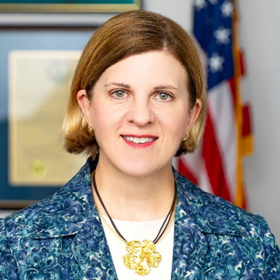
Catherine S. Read is serving her second term as Mayor of Fairfax City, elected as the city’s first woman mayor in 2022.
She currently serves on the Metropolitan Washington Council of Governments (COG), Northern Virginia Transportation Commission (NVTC), Northern Virginia Transportation Authority (NVTA), and Northern Virginia Regional Commission (NVRC). Additionally, she serves on the Virginia Poverty Law Center Advisory Board and the Equality Virginia PAC Board.
A Fairfax City resident since 2000, she came to the area in 1981 from Southwest Virginia as a sophomore at George Mason University. She has most recently worked with local nonprofits on legislative advocacy and messaging, and continues to occasionally host television shows for Fairfax Public Access.
Read earned a B.A. in Government and Politics from George Mason University in 1984 and is currently on the Alumni Chapter Board of Mason’s Schar School of Public Policy and Government for 2024-26. In May she was the Schar School’s Commencement Speaker for the graduating class of 2025.
She has three adult children and resides with her husband Tom Greeson and their dog Reggie.