By Brittney Dalmas and Christine Dua (Cohort 29)
Since ODKM’s inception, Learning Community events have been the root of the program, providing students with an opportunity to plan and execute a day-long event while also opening a space for dialogue with alumni and other organization development and knowledge management professionals.

Currently in the program, there are three LearnComms each year, with topics chosen by the team putting each event together, as it has always been. In this article, members of each planning team reflect on their LearnComm experiences and invite the ODKM community to reflect alongside them.
The topics for this year’s LearnComms were varied and stimulating:
- September: Inner Development for Outer Transformation. Planning team: Leslie Comer, Holleigh Graham, Eli Hamadzada, and Lani Pendleton. Read more about this LearnComm that was previously covered in the September 2025 ODKM Learning Edge as well as how the Inner Development Goals are being mapped to the curriculum.
- November: Values-Driven Explorer—Your Guiding Star. Planning team: Phoebe Crow, Brittney Dalmas, and Levance Everett, III.
- January: Where Voices Meet—What does it mean to have a true seat at the table - not just an invitation to the room? Planning team: Stephanie Abbey, Christine Dua, and Zen Makonnen.
From the Trail: November’s Learning Community Reflections

In November, colleagues gathered virtually for the Learning Community, Value-Driven Explorer: Your Guiding Star, facilitated by Cohort 29 members Phoebe Crow, Brittney Dalmas, and Levance Everett, III. The session offered participants a welcome pause from daily demands, creating space for reflection, dialogue, and deeper exploration of how personal values shape decisions, interactions, and professional practice.
Throughout the program, participants examined the evolving nature of values and the factors that influence alignment in complex or uncertain situations. Conversations moved beyond simply defining values to exploring how they guide actions, influence relationships, and surface tensions in real-world scenarios. Many participants shared that they gained greater clarity around their own “Guiding Star,” using the framework to articulate priorities and strengthen self-awareness.
Guest speakers Dr. Julia Kukard and Dr. Nick Lennon enriched the experience, offering perspectives on how values evolve and how they intersect with the ethical and relational dimensions of our work. Their insights helped participants deepen reflection while connecting personal awareness with broader professional contexts.
The Learning Community also invited reflection on internal barriers to values alignment. Discussions encouraged participants to consider how habitual patterns, assumptions, and competing pressures can influence behavior, even when intentions are clear. By the close of the session, participants were actively connecting personal values to the relational and ethical dimensions of their work.
Overall, the November Learning Community reinforced the value of intentionally creating space for reflection and shared exploration. The experience highlighted how thoughtful dialogue can foster greater awareness, clarity, and connection, even within a virtual setting.
For those who were unable to attend, or for participants who wish to revisit the experience, we invite you to explore the interactive Mural board capturing reflections and key themes from the session.
Reflecting on Where Voices Meet—From Invitation to Belonging, January’s LearnComm
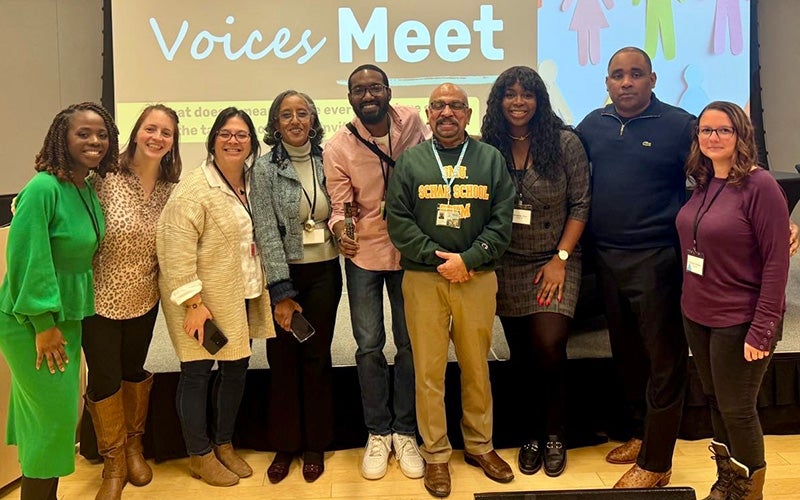
Closing out Cohort 29’s Learning Community series, Stephanie Abbey, Christine Dua, and Zen Makonnen hosted, Where Voices Meet: What does it mean to have a true seat at the table - not just an invitation to the room? Centered on the core principles of belonging, advocacy, and stewardship, the learning community reflected the foundational pillars that anchor the ODKM program and extend across its curriculum.
The January 31 LearnComm explored a timely yet complex question: What does it mean to move beyond representation toward belonging? Today, as organizations and communities strive to create spaces where all voices can be heard, the challenge extends beyond representation alone. Approaching their topic with intention, the planning team drew upon their ODKM experience by leaning in with curiosity while remaining thoughtful of broader implications.
Due to the uncertainty of the weather, the decision to proceed in-person was not made until 24 hours prior to kick off; however, the planning team remained hopeful in seeing their vision come through. As founder and president of XPERIENCE, LLC, and long-time OD practitioner, Cliff Kayser reflected, "In many ways, connecting in-person and sharing space has never been more important. Additionally, the power of community, embracing the tensions it's experiencing, together, has also never been more important.”
The event design became an immersive experience for participants to engage and reflect, grounded in research from Dr. Rosalind Cohen (2023) on inclusive leadership, as well as scholarship by Bernardo M. Ferdman, Jeanine Prime, and Ronald E. Riggio (2021) on leveraging inclusive climates within diverse teams in the workplace. These works supported a curated agenda, including an emergent icebreaker, moderated panel discussion with Q&A, guided inquiry stations, and reflective debrief.
An essential feature of the day was the moderated panel discussion, which brought forth perspectives spanning three decades of the ODKM program. The panel consisted of ODKM alumni Max Brown (Cohort 6), Shashuana Littlejohn (Cohort 14), and Jackie Duffus Boyd (Cohort 28), joined by Dr. Terrance Sanders. Through an hour-long dialogue, the panelists engaged in civil discourse about lived experiences, both in continuity and in evolution within their own unique identity and then answered questions from the moderator and by the audience.
Observing the crowd as they posed questions to the panel, Kayser noted how being in George Mason’s OD community was refreshing due to its “long and storied history and to contribute in my own small ways to advancing it.”
During the second half of the event, participants transitioned to guided inquiry stations, challenging how their voices showed up in real-world scenarios. The experimental component encouraged participants to dive into a deeper analysis of how belonging is practiced within the ODKM community versus how it is perceived on the outside. OD practitioner Heather Berthoud led a reflective debrief helping participants to synthesize insights and examine how these learnings could be applied in professional contexts.
Where Voices Meet became an opportunity for both reflection and a call to action. The LearnComm showcased how spaces of belonging do not just require intention, but more so, an ongoing practice of shared accountability and a willingness to engage, something that the ODKM community continues to shape for those around them.
For those who were unable to attend, we invite you to experience a piece of the event through the Where Voices Meet playlist.
References:
Cohen, R. (2023). How inclusive leaders can influence employee engagement. In J. Barnes, M.J. Stevens, B.Z. Ekelund, & K. Perham-Lippman (Eds.) Inclusive leadership: Equity and belonging in our communities. Emerald Insight.
Ferdman, B.M., Prime, J., & Riggio, R.E. (Eds.) (2021). Inclusive leadership: Transforming diverse lives, workplaces, and societies. Routledge.