

Tabitha King is a recent graduate from the George Mason University College of Science who obtained her PhD in Environmental Science and Public Policy in December 2025.
George Mason Journey
During her time at George Mason, Tabitha’s research primarily focused on the ecological and human health risk of perfluoroalkyl and polyfluoroalkyl substances, also known as PFAS, in the Potomac River. Her research experience began in 2016 when she was an undergraduate student at George Mason and started working in the Shared Research Instrumentation Facility (SRIF), which provides analytical chemistry and mass spectrometry support for departments in the College of Science. One of her favorite projects was to monitor a group of pollutants (pharmaceutical and personal care products) downstream from a wastewater treatment plant in Alexandria, Virginia. Tabitha continued working in SRIF through the entirety of her graduate program at George Mason.
Graduate Research
As a graduate student, Tabitha’s research interests shifted to PFAS with the media’s growing attention on their widespread presence in the environment, persistence, and negative health effects. At the time, there were little to no PFAS regulations in Virginia or at the federal level from the United States Environmental Protection Agency. This inspired her to dedicate her research to modeling the local threat of PFAS to aquatic organisms and people who use the Potomac River for food security, recreation, and drinking water.
Professional Development
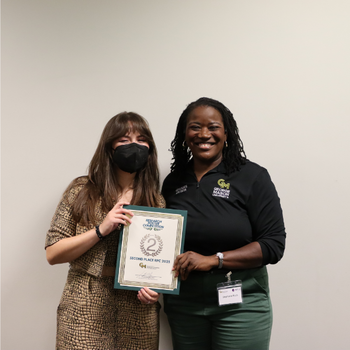
Inspired by her research, Tabitha entered the Graduate Division’s Annual Research Poster Competition (RPC) in the Fall of 2025, where she placed second among the winners. Tabitha joined the contest after she was awarded the Graduate Division’s 2025 Summer Research Assistantship and was encouraged to use the event to share her funded research with the public. Alongside this, she found the RPC to be an opportunity to communicate her findings to people outside her field and spread awareness about the risk of PFAS to local fish consumers. She noted that her work links scientific research with public policy, meaning she needs to effectively communicate her findings with the public and policy makers to make an impact, and RPC gave her an opportunity to practice this skill.
Post Graduation Plans
After graduation, Tabitha plans to continue a career in research and will be starting a postdoc position at Virginia Tech’s Occoquan Watershed Monitoring Laboratory. There she will collaborate with the United States Geological Survey, Virginia Department of Health, and local governments to study PFAS in the Occoquan River!