
In This Story

Data centers are going beyond the cloud and into the vastness of space. David Ramadan and his co-host Hina Kazmi explore this off-world progress with his guest Dr. Shareef Al Romaithi, CEO of Madari Space. Together, they explore the business, policy, and governance of space-based data infrastructure, which could be essential in building secure orbital data centers in low Earth orbit. They also discuss the colossal technical hurdles of bringing data centers into space, from the huge launch costs to the ever-increasing space debris. Discover how we can work together to ensure such an innovation can benefit the entire human race.
Listen to the podcast here:
In this episode, we're talking about something that sounds like science fiction, but is rapidly becoming a real policy and business question. Data centers in space. Why companies want them, how they might work, and what it means for sovereignty, security, and regulation. Elon Musk has suggested that within a few years, space could be the lowest cost place to run AI compute, pointing to unlimited solar power, natural cooling, and no zoning headaches. At the same time, new companies are actually building space-based infrastructure, not just talking about it.
One of those firms is Madari Space, an Abu Dhabi-based startup planning to launch orbital data centers in low Earth orbit, starting with a pilot system targeted for 2026. Madari's vision is secure sovereign data infrastructure in space for governments and enterprises, with a focus on resilience beyond terrestrial vulnerabilities.
Our guest is Dr. Shareef Al Romaithi, Founder and CEO of Madari Space, and a Pilot with Etihad Airlines. Joining me as co-host is my colleague Dr. Hina Kazmi, a Schar School Adjunct Professor and aerospace veteran with more than 25 years of experience managing major satellite and NASA missions and the architect of our new introduction to space policy course. Together, we'll separate hype from reality, talk through what space-based data centers actually look like, and explore the policy and government questions that come with moving critical digital infrastructure off the planet. Dr. Shareef, Dr. Hina, welcome to the show.
Thank you.
Shareef, please tell us your story.

First of all, it's a pleasure having me here on board, and pleasure meeting you, and thanks for the invitation. The story behind space data centers for Madari Space started well ahead of Google, Starlink, Blue Origin. I always joke around to my colleagues our biggest problem is we started three years too early. That was part of our biggest challenge that we faced.
In 2023, I was doing my Master’s in Space Operations and by coincidence, it's the year of sustainability at the UAE, as they have a different theme for every year. 2023, 2024 were both the years of sustainability and my objective was, of course, during the course of my Master’s, I realized how there is a significant shift in low Earth orbit from what used to be a predominantly governed industry by governments and large corporations to what it is now, whereby we're seeing more and more private investors going into the space sector, even so more than governments.
I figured there is a huge commercial opportunity here that I would like to explore and during this process, I would like to tie up the objectives and initiatives of the UAE, which at the time was sustainability. Through the research that I’ve done, I concluded that why not explore data centers in space to tackle the issue of sustainability.
Of course, throughout the years, this vision or agenda shifted quite a lot from not just sustainability, but now we're talking about the storage of sensitive and critical data, we're talking about supporting the AI boom, and managing data that's being generated in space generally by Earth observation satellites. Now when we're talking about sustainability, that has actually shifted towards our third phase of our operations.
Madari Space’s Mission To Bring Data Centers Off-World
We're recording this on the 24th of February, 2026. I'm here in data center center of the Eastern coast of the United States in Loudoun County, Virginia. Seventy-five percent or so of our of the world internet traffic goes through here. You are in Abu Dhabi, it is 9:00 in the morning your time. Hina is in California, and modern technology allows us to do this, but before we talk about the details of data centers and the technology itself, let's start at 30,000 feet, or I guess 300 kilometers up for you, Captain Shareef. For people hearing data centers in space for the first time, what problem are you trying to solve?
There are multiple verticals that we are addressing with our data centers in space. First of all, and I would say this is more specifically targeted towards governments, is the redundancy of sensitive and critical data. We want to provide that failover layer in space, that should any governments experience permanent data loss, we can work directly with them in the recovery process. We're seeing this trend among different nations where they are aiming to store their entire dataset elsewhere. Countries such as Estonia, for example. They have their entire national data archive stored in a completely different country in Luxembourg, which, as you can imagine, is costing them a lot of money.
Tweet: Data centers are being brought to space to create a redundancy of sensitive and critical data, providing governments with backup in case of permanent data loss.
When you're talking about countries like the United Arab Emirates, which is positioned in, let's call it a complex geopolitical region, it's extremely important to have a redundancy for their sensitive and critical data that should they experience a permanent loss, would have extreme consequences to its economy. We are here to work directly with the UAE government as well as other nations who are interested to work with us.
You talk about the year of sustainability in the UAE and the UAE has been ahead of the world on many issues nowadays. My kudos to you and your country. Personally, though, you had thought about this and at what point did you just say, “This isn't just a cool idea but it could be a viable business and a strategic play?” How is this being financed?
When we started in 2023, we came across a global application managed by the United Nations Office for Outer Space Affairs for an opportunity to host our payload on board a satellite that will be built and managed by Mohammed Bin Rashid Space Centre down here in Dubai. One of the first activities that we ever made was to apply for this application which was completely funded by myself. We spent a fair amount of our time at Madari bootstrapping our way to our progress.
When we were fortunate enough to get accepted by the United Nations, we thought to ourselves, “We have something right here that could really have an impact in the space industry.” Through our engagements with different entities at different events such as the Dubai Airshow, which hosts quite a significant number of space companies, we realized that this is actually something worthy of talking about, engaging with the UAE Space Agency.

Of course, at the end of 2023, it was COP28, which is a huge sustainability event, and right after that it was the World Government Summit, February of 2024 where I was invited to be part of a panel alongside the CEOs of various space agencies. From day one, the topic was taken seriously by the agencies and various entities. In fact, the director of the United Nations Office for Outer Space Affairs was there and we had our very initial discussion. From that point onwards, it was a serious idea that is slowly turning from a pitch deck into something real.
You mentioned cost earlier. Musk and others have argued that space will become the lowest cost way to run AI compute because of unlimited solar power and free cooling. Where do you agree with that view, and where do you think it glosses over the harder realities?
It's a very good point because we have to look and examine at all the bottlenecks that we will go through to get our data centers in space. Given our different phases that we are planning to implement at Madari, it's no way near the scale that Elon Musk is talking about, 1 million data centers. We're not facing those bottlenecks to the same extreme.
However, I would like to address one of the obvious ones is the launch service. How do we launch 1 million data centers into space as Elon Musk wants? This is just one company. Now you have other companies such as Google, Jeff Bezos is also talking about it, among other startups. This is one of the biggest bottlenecks. I think Starship, when it comes into operations, will solve a lot of these cost issues, bottleneck issues, and frequency issues to start sending data centers into space. However, it's a single point of failure. The entire industry is relying on one company.
We're seeing other launch startups emerging from Europe, from India, but of course, the cost is not the same. This is why we're all relying on Starship to be successful to start sending our data centers into space. Of course, the cost will be much lower, especially when you compare it with Falcon 9 and with other companies. However, it's something that different governments, different startups need to think about to see how we can support such activity.
Now when it comes to other bottlenecks, we're talking about downlinking the data down back to Earth, so that's already another bottleneck that Earth observation satellites are already experiencing and that is ground station operations. To the extent that several companies have to wait a few days before they can dump their data back into their data centers on Earth.
I have to emphasize that this is all data that's unprocessed, majority of which will just end up being stored in terrestrial data centers. You can imagine the cost racking up among these Earth observation satellites. Now when you add data centers in space on top of that, the strain increases, the cost will always be there. We need to really evaluate these bottlenecks and come up with solutions to mitigate such inefficiencies in the process.
How Data Centers In Space Are Structured And Deployed
I feel so futuristic talking to you. Terrestrial. I'm a professor of Political Science and a professor of practice. I come from the political world, so this is not what I deal with except with policy issues, how to get my Tesla that I just picked up to allow for full self-driving without supervised full self-driving. I want to take a nap while the car is driving. Before I turn it to Hina, I have a million questions but I’ll turn it to Hina for in a minute. For our non-Arabic readers, which is the majority of our audience, you and I know what Madari means because we're both Arabic speakers. Do you want to explain to our viewers and listeners what does Madari stand for?
Definitely. Madari can mean two things in Arabic. Madari can mean orbital or my orbit.
In your case, which one is it?
It started off as orbital but then I realized, oh what? It actually has a second meaning, which is my orbit.
Hina, why don't you take over Shareef's orbit?
Good segue. Yeah, this is great. I do want to say first of all that not only Shareef and I are in the same aerospace sector, but he and I are also actually alums and we went both went to Embry-Riddle Aeronautical University for our undergrad in aerospace so I'm really proud alum of that university. He went on to get more degrees including your PhD from Riddle. I moved on after undergrad but just wanted to mention that.
That's in Florida.
Yes and no. Main campus is Florida where I think Shareef you went. They have another campus on the West side so it's in Prescott, Arizona. That's the campus I attended. What I wanted to do, gentlemen, let's just start with some context for our audience when we talk about data centers and data center in space. Shareef, you already listed some challenges to scaling this up. I wanted to just give context as to what are we talking about here. In my research so far, there are about 11,000 data centers around the world. Yes, as David you already mentioned, Virginia is the center point. We have the largest number of data set within one governance structure within our state.
They're all within three miles of me, Hina.
That's right, around Dulles. A lot of data centers, 500 cloud service providers. I also wanted to say that as of 2024 or 2025, the amount of data we're talking about when we talk about these 11,000 data centers is about I think 200 zettabytes of data. To put it in some context for our audience, that's 200 million petabytes. I was astounded when I learned in my research that up to about 2005, so beginning of our Millennium, the estimated recorded history of all human history written and images that they were scanned all together throughout history of humankind is about 50 petabytes of data equated. This is 2005.
At that time, social media, all the streaming services and all these devices and apps, none of that really was prominent. Imagine 60 petabytes at that time and now we're talking about 200 zettabytes and we're projected to go up to, by the beginning of 2030, 500 zettabytes. That’s 200 million times. We’re talking about enormous amount of data that is now being generated and we are just at the beginning of the AI age.
We're not even talking about quite yet generative AI and 10 years, 15 years down the road, quantum computing. This exponential growth, it's really hard to process in our minds of what growth we're talking about when we say data center and need for these data centers. I also wanted to say that, just coming back to Virginia, the energy resources used by Virginia. There is a lot of opposition. We're seeing opposition, at least in the US, in other local communities in Arizona, in New Jersey because just within the Virginia, if I saw the numbers correctly, it's about 5.5 gigawatts of power and energy consumption for the data centers just within Virginia.
Now again, to put in context, what that means for average US household, about 1 gigawatt is equal to about 600,000 households. When we talk about 5.5 gigawatt of energy consumption by these data centers, we're talking about over 3 million of households that it could power. A lot of strain on our resources.
I say all this that that's the larger context of why now the big techs are saying and startups like Madari Space saying, “Let's really take going into space seriously because the resource use and strain really that we have on the systems on terra firma and other security reasons that Shareef opened up with of why we're really seriously now looking at going into space with these data centers.”
I think what we'll talk about, Shareef, later in this discussion is also that scaling up to it. We have our share of skeptics who say, “This isn't going to happen anytime soon,” and I will get into that a little bit in this conversation. For the starting point, let's just assume for a moment that we're there. Technically it's feasible, we have multiple launch options, so economically, let's say, it's feasible we're there. We've heard what Elon is imagining what these data center constellation satellites will look like. How do you vision envision this with Madari and just within UAE? What I mean by that is do you imagine also huge constellations or is it like structures like space stations, things like that? How do you see this?
Our plan from day one has been a model following a constellation model that will all be interconnected using space interlinks or free space optics for both space to space and space to ground communication requirements.
Tweet: If you are planning to send a constellation of data centers to space, it is far cheaper to set them up at the lower orbits.
These are primarily low Earth orbit?
Will be in low Earth orbit, yes, at least initially. At this phase, it will be in low Earth orbit. However, in the future, we definitely are exploring opportunities in the cis-lunar locations such as Lagrange point 1 for example and that would be primarily for long-term cold storage.
I don't know the technical reason for it. Why not look at like the GEO constellation because again it's just the data latency that's primary reason I would imagine.
Yes. Definitely.
Explain that in layman's term. What are we talking about in low orbital versus others for us non-NASA scientists? What does that mean?
Low Earth orbit versus GEO. They're two primary orbit types that we talk about there's also middle orbit. Low Earth orbit are really low to the surface from the surface of the Earth. International Space Station is in the low Earth orbit. Basically, when you have space satellites in low Earth orbit, you need multiple of them. What you get is you are closer to the Earth and so your data delay now in communication is a lot less and that's why low Earth orbit are just preferred. Starlink constellation, but you need a lot of them when you're in low Earth orbit because basically your view, your antenna coverage is just very pointed.
You need multiple satellites to give a full 24/7 coverage for wherever you want, the area you want to target on ground. GEO orbits, where my career started, we were really looking at building large geosynchronous orbits which basically reminds me about 30,000-some miles away from the surface of the Earth. That's the one point in this one orbit geosynchronous orbit where when you launch your satellite it points and it's synchronous with the Earth rotation.
You only need one satellite because it's always pointing to the area you want to cover whether it's the US or Middle East whichever region you're pointing at. You only need typical one but those are large satellites. Of course, they're 30,000-some miles away, so your data delay, you cannot accept for internet broadband or for communicating with the data center a downlinking, uplinking.
That's the advantage of being in the low Earth orbits. They're now variations of low Earth orbits. You can have multiple low Earth orbits. The closer you are to the lowest of the low Earth orbit would be right above the Kármán line, which is technically we say where the space begins so that's about 100 kilometers altitude from the surface of the Earth.
That's Kármán line where the space begins, so anything above that is your low Earth orbit. I had some number. At some point, the higher you go, the more you're getting away from middle Earth orbit, which is where GPS satellites usually navigate. Navigation satellites are orbit in the middle orbit satellites and you need less number of satellites. I should stop because I can go on and on talking about it.
An important point is also the costs. If you're planning to send a constellation of data centers, it's far cheaper to send them to low Earth orbit compared to higher orbits.
Data Centers In Space As A Regional And National Strategy
Let's talk about policy for a little bit. Shareef, you're in Abu Dhabi, as we said. The UAE is leaning hard into AI, data, and space. How important is this as a national strategy, or even a regional strategy? The UAE is part of the GCC, the Gulf Cooperation Council countries, for making this viable, versus just a startup with a cool idea that versus Shareef's Madari. How important is that to you as a country, to you as a region, versus Elon's American satellites that are going to be up there?
You will clearly see the difference between the direction that Madari is taking versus what Elon wants to do. Elon is focusing primarily on AI, which I would say addresses more of the United States agenda. Although the United Arab Emirates does have an extensive AI initiative, I think nowadays, what's more important to the UAE is securing their national data.
Having that data sovereignty and having that failover redundancy layer in space, should they experience permanent loss of their national data. This is what really drove our phased approach into deploying our data centers in space. We want to start first by storing sensitive and critical data. In parallel, this would generate a revenue stream for us that would support our R&D efforts to mature our second generation of data centers that would cater for AI applications and inferencing in space. This is primarily to address the requirements and the objectives of the United Arab Emirates and neighboring countries as well.
Madari's public messaging emphasizes "sovereign data management" and secure dedicated orbital data centers for government enterprises. In practical terms, what does sovereign mean here? Is it jurisdiction, control of hardware, control of keys, all of the above? Define the sovereignty here. Who owns what in space?
It's basically all of the above. When you're talking about the launching part of the satellite, of course that would be governed by the launch state based on outer space treaties, along with other UN policies and regulations. However, when it comes to the data itself, and this is something that we're already experiencing with the Kingdom of Saudi Arabia, the data needs to be owned by the country. There's no other way around it. For example, the regulators in Saudi Arabia requires that every single piece of the operations to be within the jurisdiction of the Saudi Arabia.
What's operations here, meaning the build up?
Who will be running the satellite or the data centers, the ground stations that will be used to transmit data up and down, the terrestrial segment of data management needs to be within the country as well, which alters how you operate a constellation of data centers. Since you are restricted for example to ground stations within Saudi Arabia, that would ultimately limit how frequently you can talk to your data centers, depending on how big your constellation is. If you're talking about 1, then you're really limited compared to having 100 or 200 data centers in space. With regulations and with policies, limitations will fall in place that we as the R&D player in the picture have to find solutions and mitigate it to comply with their requirements.
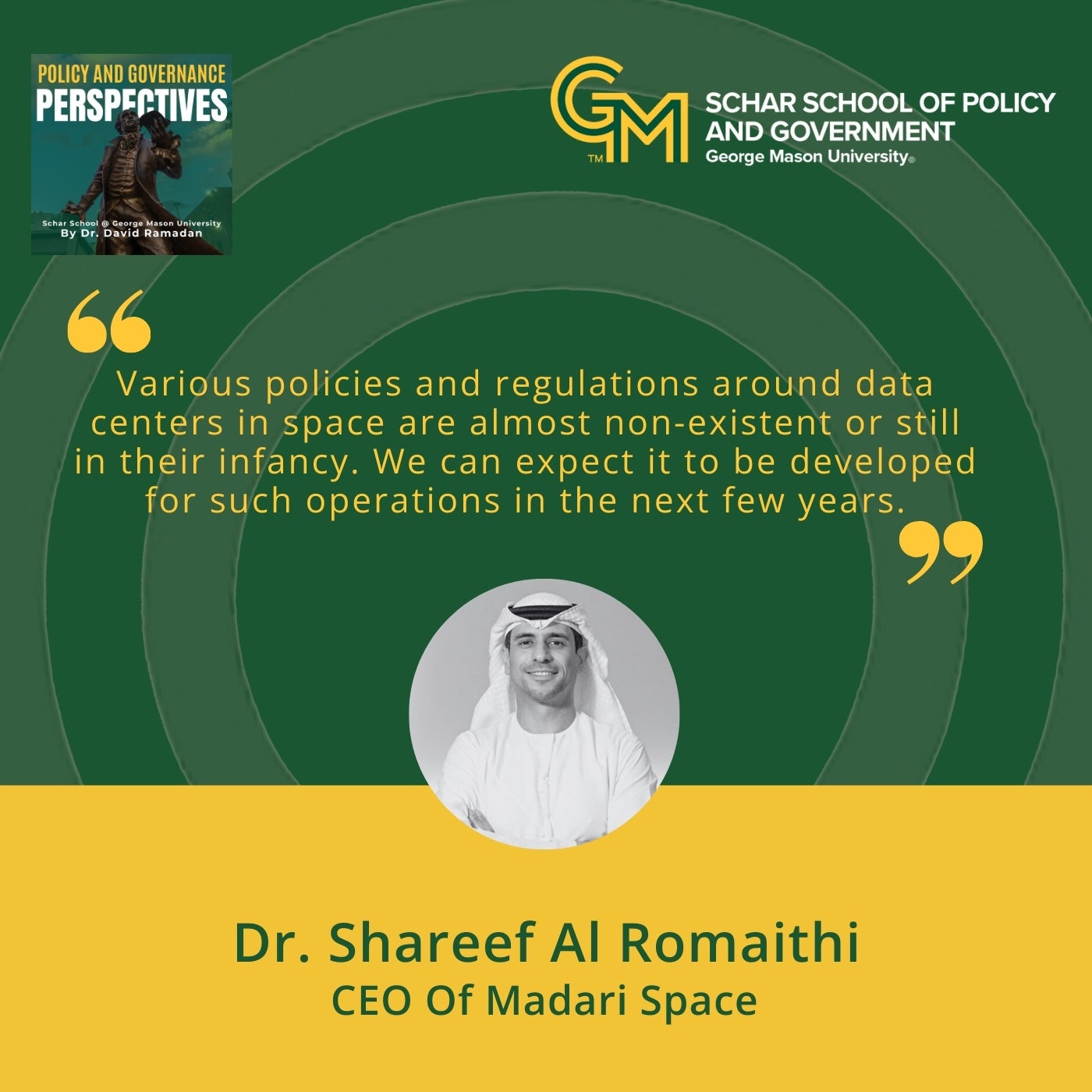
When you look at different policies such as in Europe, for example, the GDPR where it restricts cross-border data management, that would also be experienced within the EU jurisdiction. Given the fact that the concept of data centers in space is still new, I would say various policies and regulations are almost nonexistent if not they are still in its infancy and we can expect within the next few years various policies and framework to be developed to cater for such operations.
Hina, you had a question?
I just wanted to say how it started out, in the introduction, opening remarks, how the UAE and the degree, the Gulf region has really developed our economically. There's been huge, you called it magical, the development that we've seen.
Why is magical?
I haven't been there yet. What I did want to say something but should mention is really important for their region is that me being in the sector for many years now, mostly in the US, seeing the Middle East, really growing this sector so fast. What he's saying is about not just be user and users of the data. They want to own the upstream infrastructure and downstream processing data, not just the raw data.
I think these are all steps towards becoming that the space infrastructure-based economy in that region is New because we, of course, in the US and the Europe, we understand their products for Russia and China catching up soon, but really, it's a really new advanced development in their regions. I just want to highlight that.
Making Data Centers In Space Technically And Commercially Viable
Thank you. Let me follow up on the previous question and then turn over to you again, Hina. Shareef, you mentioned that your pilot will be up in 2026. What's your minimum viable mission? What do you need here for the system to prove technically and commercially viable?
First of all, unfortunately, we are experiencing a delay for launching the first prototype, so it's been postponed to 2027. That's the mission, I highlighted briefly at the beginning of the session through the United Nations Office for Outer Space Affairs, and Space Center. That's been postponed to 2027. Around Q2, Q3. However, what we aim to demonstrate in this mission is basically data storage and compute capabilities in space.
However, the overarching objective is how can we take commercial of the shelf products such as Nvidia, for example, and make them space great, to understand where they can operate within a parameter, limited temperature variations. They can withstand radiation, and so on, and so forth. More importantly, solid-state drives which are completely inefficient in space when it comes to the impact of radiation. In fact, we're planning to run a few radiation testing campaigns in a couple of months where we'll be testing multiple storage components from various companies and see how we can shortlist our selection process to use the most efficient.
Our plan is to basically store, compute. We're planning to attach a camera on board as well, mainly to generate data. We're not interested in Earth observation applications but we just want to generate data to run various AI applications. For example, we have, right now, two different AI models. One is to optimize images. In case you have images covered with clouds, we're running AI applications to remove those clouds and optimize the image in terms of the data value that you capture from it.
The second one is for detection of ship movements. We're planning to take different images of maritime operations and detect different ship movements in that area. Secondly, we're planning to run the first Arab LLM that has been developed by the UAE by a university. We'll be running it in both Arabic and English. This would be an introduction to entrancing applications for future space operations.
The mission duration is one year. We'll get an opportunity to really put our hardware and software to the test across multiple points. We discussed the thermal management aspect, which is a huge concern. However, for us now, it's not as a big concern as it should be mainly because of the power requirements that we need for that particular mission.
However, we're already preparing for future bigger power budgets. Our biggest concern for this mission would be radiation. Although we are in law of orbit, it is still a concern when you're talking about data management and storage of data, and then thirdly, is there software aspect in terms of AI applications and processing of the data in general.
Most of that, I got. I am the person who when people talk about their data is in the cloud, I smile because it's literally one mile away from me in the big data centers in Loudoun County. Not really in the cloud, but I do understand the constraints. There are many of them. Hina, why don't you take it over to talk about constraints on a technical and scientific level?
Yeah, okay. We'll try to keep it as layman. I'm no expert in some of this stuff either. Thanks, though. I think I wanted to also touch on what is the R&D side of the work you're doing and you explained some of the project that you have in cue. Of course, I'm sure that at least in my network of space geeks, there more skeptics of this, “Data centers in space, not in our lifetime,” but there are also believers.
I believe that we're going to get there, not tomorrow, but I think in ten years, something along these lines will have some capacity in space, I believe. You mentioned several of the technical constraint. Just space hardware and scaling it up to the type of data centers we're talking about, of course. You also talked about we need more capacity to launch.
Launch vehicle, we need large vehicle capacity so makes it more economical and we're not single point failure, meaning just reliant on one provider. I don't know if you agree with this or not but there are small to medium large launch vehicles. I would I say they're in the cue ready for operations. They're in development by multiple companies. I would even not even call them startups at this point, Rocket Lab of course, Blue Origin.
Once their rockets come online and really operation ready and even Firefly's partnering with Northrop now on the small rocket. Of course, we're not even talking about India and China and their capacity. I feel that the launch costs will come down as we add these suppliers but of course, this is in the coming I would say in the near future, in the next five years perhaps.
Let me ask you on the other side. Again, jumping ahead, we get over these technology hurdle but again, to scale up, there are things like in orbit space servicing maintenance manufacturing which ISAM is the acronym we typically use in space manufacturing assembly servicing. To me, it seems like a very critical component once you even get there. I don't know if you see that initially. Maybe that's not your immediate concern or is it? Robotic capabilities to be able to do some servicing in orbit servicing for some of your satellites or is that maybe a even a farther down the road that capabilities needed? What are your thoughts?
Kevin Costner will be too old to go up and fix them.
That's right. Short-term, we don't envision such requirements. However, long-term, who knows? Robotic arms to conduct various replacements for hardware could be a solution to some of the future problems that we may face. However, if you look at the Starlink model, for example, I think this is a perfect cross analysis of what a future data center may be. In fact, Elon Musk's plan is to integrate data centers within his Starlink constellation.
I think it will be far more practical for the short-term to simply replace those data centers or replace them with an upgraded generation. As you're developing your R&D, you're advancing with your technologies, rather than having robotic arms to conduct various replacements, it's just easier to perhaps replace that particular data center or satellite with a far more superior generation.
Thus, what you added for later on, why low Earth orbit satellites are more economical to launch because they can be easily replenished.
For the layman guy, I might if I may interfere for just a second. Replace here, do you go grab it or do you just abandon it and put another one up there?
Just the orbits, depending on your orbit planning or the orbiting. Back to burn through the atmosphere or you're sending it over to deep space and you sending a new one. That's what Starlink has been doing for the past years.
I have more question, David, if we have time?
Absolutely. The floor is yours.
Required Collective Action To Bring Data Centers To Space
In the US, Shareef, we when we talk about R&D and we're in a very R&D phase but something that I really do believe is going to happen, I hope in my lifetime, we will see some operational data scaled data centers in space. A lot of the R&D work in the US primarily takes place in partnership with the academia. Government invests a lot of research dollars in universities within through their own agencies and with the partnering with the private sector and startups like yours. Give us a sense of how is that happening. Are you partnering with space agencies or academia or the industry. Give us a sense of that.
If you recall, you mentioned how many degrees I’ve completed from Embry-Riddle. You can tell how much I'm a big fan of academia and I always rely on academic institutions to support our mission. It's such a complex concept to develop alone and to rely on the industry because the industry has its own implications, they have their own challenges to just rely on them when you have a very reliable source such as universities that could support your R&D efforts as well.
It’s far more cost effective compared to the industry. This is exactly what we're doing. We're adopting a hybrid model where we are tapping into both sides. We are working directly with universities for to access really smart and talented graduates whether it's for internship opportunities or more permanent roles, as well as access to space labs and clean rooms that are completely free of charge, thanks to the mandates that the UAE government had put in place to support startups like Madari.
We have access to multiple universities across the country where we can conduct various tests such as vibration testing, thermal testing and so on. An entire AIT facility is at our disposal free of charge. You don't get to see this anywhere across the globe. This is one of the benefits of running or starting a space startup in the UAE.
However, in parallel, as I mentioned, we are also working with the industry. UAE Space Agency. Of course, at the top of our list, we're working with the innovation hub at Dubai DIFC. We're working with Thales Alenia Space in Europe out of Toulouse as well as one of our strategic partners is also another space startup based in Paris. We're working alongside with them as well. We have briefly engaged with the Estonian government to see how we can work together in the future. In fact, I had met their president during the World Government Summit. I would say we're having a mix of everything. As a startup, we have to be agile. We have to try everything. Knock on all the doors, basically.
Sounds good. Back to you, David.
We would love to perhaps, after this show, stay in touch and talk a little bit about cooperation with George Mason, Shareef. We're the largest public university on the East Coast. We have 40,000 students, 10,000 of whom are engineering students. About 3,000 or 4,000 are policy and government students. You can tell that with Dr. Kazmi, we are interested in space policy and we teach it. Perhaps we can include your amazing team in Washington, DC, your country's amazing team.
Biggest Policy Red Flags Of Data Centers In Space
Ambassador Al Otaiba is somebody I met several times. Yousef is great and perhaps we can start a three-way discussion there because we'd love to chat with you about student exchange and student work as well. Let's take it back to policy, if you both don't mind, for a second. Hina, let me ask you, actually. You're teaching space policy here at the Schar School and you talk about space as critical infrastructure. When you talk or you hear about space-based data centers, what are the three policy red flags or questions that come to mind?
A few come to mind but immediately, the top three, I would say, is first and foremost, probably more at the domestic level, which would be that with the current capability and ambitions of the big tech companies and spacex, which is big tech almost but also major space company. When I think of these big companies really saying okay we're going to scale up we're going to go out and launch these data centers space, which all sounds good, but right away, I think of the cross-sector vertical integration that we're seeing in some select companies. Right away, I think of too big to fail.
That reminds me of the 2008 financial crisis. We're all old enough to remember that very well and that was a financial institute crisis. It was felt around global globally. I feel that if we are perhaps building this capability allowing companies going cross-sector this vertical integration, it’s probably bigger than financial institutes because data and now we’re talking about perhaps a handful of companies having upstream capabilities in space and downstream. By the way, putting data centers in space, the traditional critical infrastructure that's in space. Space becomes even more critical and data, as we have been talking about is just the backbone of everything we do now.
I think that's the first red flag that comes to me. Are we going to end up with a company that are going to be too big to fail and we really are going to rely on them. What does that mean policy-wise domestically? Should we look to the FTC and FCC? There were a lot of lessons learned after the 2008 that this should never happen again but are we blindsided to the tech companies becoming too big to fail? That's something that really comes to my mind because these data center, as Shareef mentioned, are going to be owned really by those providers and they're investing so much capability and this is going to be a costly venture. Eventually, we'll get there, so that's one thing.
International red flags as well?
Yeah, you could say that but right now, I’ll just say it. Spacex is the one. They're based in the US. You can call it a global company, which I think it is becoming pretty fast with the Starlink capabilities. It's impressive. It's amazing what spacex has done. You just add more and more what I call cross-sector integration and we're all relying on it.
We have Amazon becoming the next one in big data center so what does it do to the small startups like Madari and how do they then strategically partner and stay in the game? I think that's a very valid concern that we're seeing out there, not for data centers yet but for small satellites. I think it's continuing on this thought is that the just we need new rules of the game.
New global norms is being talked about at the UN Office of Outer Space Affairs, UNOOSA. Is it time for us to sit down to really talk about different global norms meaning in war or peace, how this critical infrastructure, how do we protect it how do we really take it seriously because this is a global phenomena? I think that comes to mind. When are we going to really sit down around the table. I think of G20, by the way.
What I think about having these multilateral discussions, not just the G7 or G3 or G5. We really talking about G20 because these top 20 nations and Middle East region is part of among G20, are these space capable nations now? Really got to have a multilateral discussions and agreements, which I think be important so that's something comes to mind.
Maybe Shareef may have some conflict of interest but I'm going to have to say it anyways. I think when we talk about low Earth orbit set, like these mega constellations, so we call them mega constellation, they're in low Earth orbit they're in very low Earth orbit now like barely above the Kármán line. What the new concern that's evolving, and I’ve been talking about it but I haven't done enough homework. I'm not a scientist so I can't really talk in detail about it.
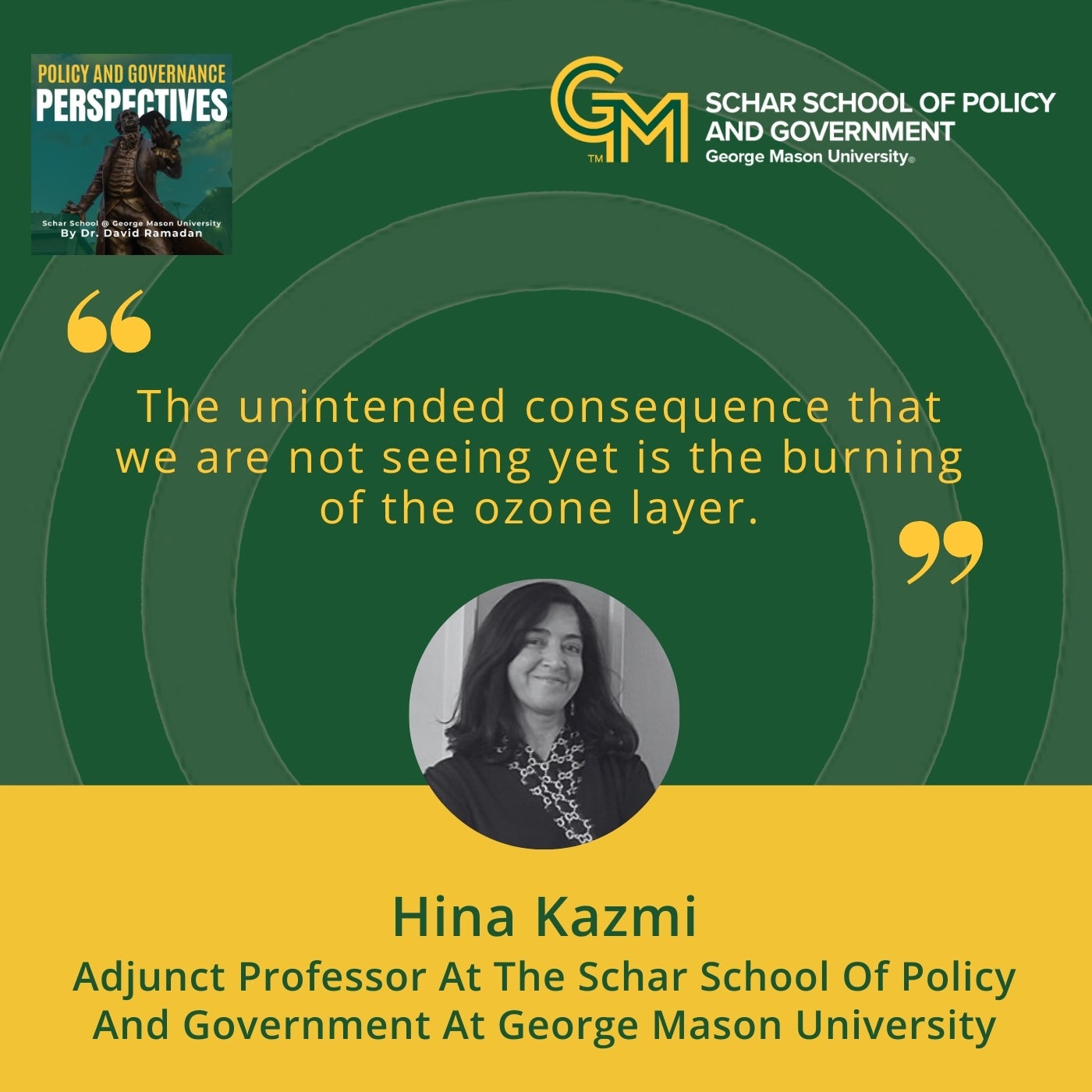
The scientists are raising a concern there how many satellites in the low Earth orbit that burn up in the upper atmosphere because along with being cheaper to launch, they basically need to be recycled so they need the lifetime of a very low Earth orbit satellite, which is 3 to 5 years. They wear out because they burn up. They wear out faster so you have to replenish them faster. That's why they're cheaper to upgrade and do all of the thing that Shareef mentioned. I think what's on the unintended consequence that we are perhaps seeing or not seeing yet but the scientists are getting alarmed to is that ozone layer.
How much is enough to burn through the upper atmosphere and what basically is above the ozone layer. It's stratosphere. Remember, the Laws of Physics don't go away. Energy doesn't disappear. It converts into something else. When you burn up all this material, it doesn't just disappear. Some of it remains in very minute microparticles.
Some say the meteorites shower. We get shooting star. We can handle this. This is nothing compared to all the meteorites we get. We actually are starting NASA's starting to measure the effects of satellites burning through the upper atmosphere and it's very small effect right now. If we talk about million of satellites in low Earth orbit for data centers, what does that mean? I think that's a very valid concern that we're seeing out there.
What does that mean, Shareef? I think she's asking you, not me. How much is enough? What does that mean?
We're already seeing aluminum particles in our atmosphere because of the deorbiting of satellites. The problem is various research facilities are still exploring alternatives to building satellites that would not cause such impact on our environment. In fact, a Japanese firm has explored building satellites out of wood and I believe they've already sent their first prototype but it's a big challenge. How do you pass a vibration test using wood?
Sustainability is a huge impact and it's a huge story that we need to take care of, not just when we're talking about space data centers but Earth observation operations. That's a huge segment. That's actually one of the most profitable businesses right now in low Earth orbit. We're seeing more and more startups entering this field. Going back to the space data center operations, it would ultimately support in parallel the development of data centers in space.
However, now we're talking about aluminum deposits in our atmosphere. We're talking about space debris in low Earth orbit. When you're talking about the policies and regulations in place to govern such space debris issues, it is still in its infancy. We still need to work with the governments, with the United Nations to develop the required framework to take care of such issues.
For example, a US based company has no rights to touch the space debris of let's say a Russian satellite because that still remains the ownership of that Russian entity. How do we end up developing such policies and finding that common ground that would benefit everyone? There's still a lot of work ahead of us and the industry is not slowing down for such regulations to come in place.
Putting Guardrails Around Off-World Data Centers
A follow up to that, what guardrails should be there so we don't end up with a Wild Space West up there without stifling innovation? Is there any guardrails that you can envision, Dr. Al Romaithi?
Definitely. There are certain standards that have been put in place as recommendations to how do you operate and manage your satellites in terms of future deorbiting plans towards the end of your lifespan? This is one area that is gaining a lot of attention and now, we're seeing a lot of these satellite operators, in fact, integrating such considerations into their design to ensure that they do not contribute to the space debris problem in low Earth orbit.
Tweet: We do not want to contribute further to space debris because it will impact us all. We need a deorbit plan if we want to avoid collisions in space that would result in more debris.
As we look into the future with the plans to have a constellation in space, we definitely don't want to contribute further because at the end, it will impact us as well. We'll have to have a deorbit plan in place. We'll have to have a plan to avoid collision with existing space debris that would ultimately result in millions of more space debris. These are two areas that are on the table right now for us to be managed in the future. In fact, this is a topic that is being addressed by all satellite operators.
Will Data Centers In Space Become Mainstream?
I have a million other questions and I can talk for two more hours learning from both of you but let me bring it back to our students ask you both couple questions. Dr. Al Romaithi, you mentioned academia earlier. I believe you have 4 or 5 degrees. You have a Bachelor’s, you have a Master’s all from the same university, all on the same topics or similar topics but in the same field, a Doctor degree.
You then went back for a Master’s after that. You're a glutton for punishment, my friend. You're a pilot, you're a founder, you're now a space infrastructure CEO. If a George Mason student came to you and said, “I want to work on these kind of things in ten years,” what skills and experiences should they be building now?
Having a good understanding of the impact of the space environment on hardware and software, that's a huge advantage. One of the biggest challenges that we are trying to solve and I'm sure other space data center startups are trying to solve as well. Simply put, we're not meant to be in space. Humans, hardware, nothing is meant to be in space. However, there are ways to mitigate it and being able to understand the impact of radiation, for example, on hardware, this is huge. Now, you don't come across many professionals with in-depth understanding of such topic, which would be of great value to future space operations.
You obviously believe in it, otherwise you wouldn't be doing it. You obviously believe that even though we're not meant, in your words, to be in space, you believe it can be done. It can be mitigated, as you said. In preparation for this episode, I texted with a friend of mine here who is known for his data centers development work in in so on ground and he said, “That's a fringe section of our of data centers.” He called you guys fringe. Put that aside, is it going to remain to be a niche or is it going to become mainstream?
I think for the foreseeable future, it will be a niche market. I would say maybe 10, 15 years. A lot of factors will have to all line up to for it to become mainstream. Nowadays, if you want to upgrade your data capacity on your phone you're paying I think it's $1.99 per month for additional cloud storage.
There's no way you can pay the same price for additional storage in space. This is exactly why we're not addressing the public now as a main customer pipeline. We're focusing on governments, large enterprises, focusing on sensitive and critical data.
Tweet: Everyone should come together to develop frameworks, policies, and regulations around sending data centers to space.
We're not here to store your family pictures. Although we do want to in the future, but we need to match a price point that you, as a customer, will be able to afford it on monthly basis. For the next, I would say ten years, at least, we can expect this to be a niche market, addressing certain market segments to a point where it becomes very mature. The cost reduces across the board from launch to operations to manage to managing the data center in space. That's when we can expect the public to start engaging with us.
Thank you for that. Final thoughts from both of you, please. Hina, you go first.
I guess I’ll pick up on where Shareef just left off. It is really where we are right now. It's scaling up to eventually have data centers space. It is a long-term strategy but it is government and public private partnership, so government is very much still a factor of it. We like to say and I love to talk about commercial space economy. I talk to my students in class but government is so much part of it so it's not fully commercial.
Scaling up to really build these data centers and this backup capacity in space really working with the government and then at some point we will mature. All the constraints, we will get over all the R&D constraints and it really be production and operational and then we will scale up. Yeah, I agree with Shareef. It is at least 10 years away or 10 to 15 years, if not more.
You asked about think about the students. I always say we need all the expertise, all the career areas to really work in the space economy and we need those scales, not just to boom further expand the commercial space economy but just policy perspective regulatory perspective. We touched on some concerns coming up. I say okay, it's no longer just technical folks that we need. We need international affairs folks who understand space domain.
We need regulatory folks. We need students to come out and work in I’ll talk about the US regulatory side, FTC, FCC. I mentioned these already. Who really can understand why do we need to have some guardrails, like you asked earlier. Lawyers, we need all those skills and spaces now. It requires all those skillsets, not just select. That's what always my advice is for students to think bigger. Space needs all kinds of skillsets. I'm excited for Gen Z.

Shareef, final thoughts?
I think I have a very straight to the point simple message that I would like to share. If you go online now and research or Google space data center, you'll come across several articles that use the term the new space race. In my opinion, it implies it's a competition, which to a certain extent, it is. In my view, in order for this to become a successful new business segment, we really need to work together across the board.
I understand competition plays a role. However, it's such a big market that now, there's about ten companies globally working on this business concept. Even just the ten of us are not enough to sustain the future demands. I think it's best for us to work together, share knowledge, share results of payloads that we've sent into space, come together and see how we can improve the technologies to reach a point where this becomes a reliable, secure and common business activity in space.
This should happen not just among competitors in the market, but among space agencies. Regulators, we all need to come together, develop frameworks as we discussed just now about the policies and regulations that need to come in place. The United Nations Office for Outer Space Affairs will play a big role in such activity. I'm waiting for the day when there's a global event dedicated just for data centers in space and I hope I’ll be there.
Hosted in Dubai?
That would be a dream.
I’ll tell you, I can help you on the policy side. Consider this an invitation on behalf of the Schar School of Policy and Government, not just from me. I'm a former legislator, former member of our state legislature Parliament here and we can work with you on rules and regulations. On behalf George Mason as well as all of our schools, we would love to work with you and find any way that we can coordinate together.
Dr. Al Romaithi, Dr. Kazmi, thank you both. This is one of those conversations where technology, strategy, and policy all collide. I think our reading will be hearing much more about space-based infrastructure in the years ahead. Until next time, stay informed, stay curious, and remember, the future of infrastructure may not just be underground or underwater, it might be overhead. Until next time.
Thank you very much.
Thank you.
Important Links
About Shareef Al Romaithi
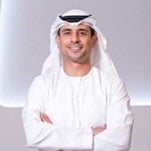
Dr. Shareef Al Romaithi is an Emirati aerospace entrepreneur and the Founder & CEO of Madari Space, a deep-tech company developing sovereign space data centers and edge-AI compute infrastructure in Low Earth Orbit (LEO). His work sits at the intersection of space architecture, digital sovereignty, and advanced computing, positioning space-based data infrastructure as a strategic layer of next-generation digital and sovereign technology ecosystems.
With a background in aerospace engineering and advanced academic credentials in space operations and aviation safety systems, Dr. Al Romaithi combines operational discipline with forward-leaning innovation. He is a NASA HERA analog astronaut alumnus, having completed a 45-day isolation mission simulating deep-space exploration conditions, an experience that further shaped his systems thinking, risk management philosophy, and commitment to resilient mission design.
Through Madari Space, he is leading the development of on-orbit data storage, AI inferencing, and secure digital custody capabilities designed to support governments, defense entities, financial institutions, and Earth observation operators. His broader vision centers on enabling sovereign, sustainable, and high-assurance digital infrastructure in space, contributing to the UAE’s leadership in the emerging space economy and the evolution of space as a strategic domain for data, security, and advanced computation.
About Hina Kazmi

Hina Kazmi is an adjunct faculty at George Mason University where she also achieved PhD and Master’s in Public Policy degrees. She teaches courses on Space Policy and Government Outsourcing. She has spent nearly three decades in the space sector, working for trifecta of industry, government, and nonprofit research institutes.
Kazmi has led civil and commercial space programs in both technical and management roles. As a civil servant, Kazmi directed multiple Congressionally mandated policy studies at NASA Headquarters to help facilitate strategic investment decisions in the post-Space Shuttle era. She has an undergraduate degree in Aerospace Engineering from Embry-Riddle Aeronautical University and an MBA in Technology Management.