In This Story
The Department of Bioengineering hosted its 2026 Bioengineering Networking Force Event (BNFE), bringing together students, faculty, alumni, and industry partners for an evening focused on career development and research excellence. The annual event featured a panel discussion, employer networking session, and a research poster competition.
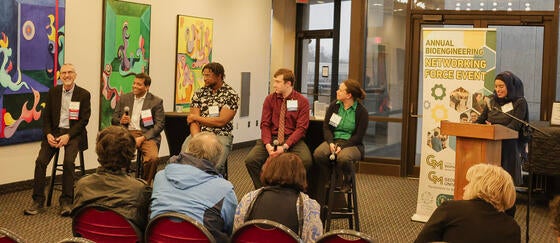
The evening opened with a panel discussion featuring David Hamilton, Prakash Kolli, Shani Ross, senior Jacob Lockey, and master’s student Gabriel Gibson, moderated by Sally Farag, president of the Graduate Association of Biomedical Engineering (GABS). Panelists shared insights on navigating careers in bioengineering, the importance of perseverance and cultivating soft skills, and opportunities within the region’s growing biotechnology sector.

An employer networking session with regional and national organizations followed the panel. Representatives from the American Type Culture Collection; Women in Bio – Capital Region; Thesus Health, Biodesign Innovation Labs; the United States Patent and Trademark Office; Conscium; the Fairfax County Economic Development Authority; Vasoptic Medical; and, several additional companies met with students to discuss internships, career pathways, and current trends shaping bioengineering.
A graduate research poster competition ran during the event, highlighting innovative projects across biomaterials, computational modeling, biomedical imaging, wearable medical devices, nanomedicine, and neuroscience.
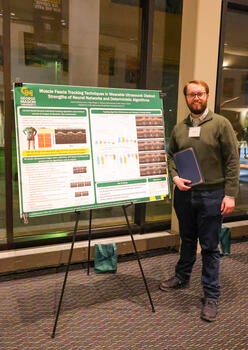
Posters were evaluated by judges from academia, industry, and research organizations, including experts affiliated with Blue Origin, Weinberg Medical Physics, Vasoptic Medical, and George Mason bioengineering faculty.
BNFE continues to strengthen the pipelines between George Mason’s talented students and the region’s bioengineering industry, while providing a platform for graduate researchers to share their work and build professional connections.
“Events like the Bioengineering Networking Force Event are essential to our mission as a department,” said bioengineering chair Ketul Popat. “It’s an opportunity for our students to connect with industry leaders, showcase their research, and build the professional relationships that will shape their futures.”
BNFE 2026 was made possible through the support of the Institute for Biohealth Innovation, GABS, the Biomedical Engineering Society, and the Department of Bioengineering.